Showing posts with label chickens. Show all posts

Friday, January 11, 2013

State of the Art Chicken Defense System

What do you think of the chicken’s new decorating scheme? Makes the place feel like a constant party. Unsurprisingly, the girls were not impressed. But no matter, the effort was to protect them, not impress them.

Last year when I allowed myself to be talked in to purchasing 28 chicks over the phone by a friendly, enthusiastic man at a hatchery in Iowa, I thought I was hedging my bets. After all, we lost eight chickens in one fox attack the year before and the dog had already nailed three by spring. So 28, while a ridiculous number of chicks for a family based operation, seemed reasonable when you consider the inherent dangers of living on this hillside.

All of the chicks, save one, made it through the summer. I was feeling flush; I even gave six away to friends whose own flocks had been decimated by age or sharp-toothed felons. I was in the midst of negotiating a deal to relocate another hen contingent on a rooster accompanying her (anyone else need a rooster?), when the siege began.

My husband and I were all cleaned up and headed out for a night on the town (or at least a game at the local brewery), when we heard panicked shrieking from the chicken pen. We dashed in our finery to the muddy pen and discovered a hawk having dispatched with one hen, surveying the others and choosing dessert. We shooed him out and hoped we’d scared him as much as he scared us.

Apparently not, because over the next few days chickens began to disappear on a daily basis. What to do? It’s illegal to shoot a hawk. They’re a protected species. I have a hard time understanding why we’re protecting them; they seem to do just fine on their own. No matter, we don’t own a gun. I did half-jokingly ask one of my son’s friends, an accomplished hunter, whether he’d be interested in the job. He wondered about the legalities of taking out the bird. Smart kid.

And it wasn’t just the hawk eyeing up our birds. We have a dog, which claims at least a small amount of hound pedigree, who is not the sharpest knife in the drawer. That’s the nice way of saying it. She barks at the horses, as if she’s never seen them before, yet bounds out to greet any stranger who walks up our driveway. She threatens to kill the cat on a daily basis, only to back down the minute the cat turns around. She does not come when she is called and bursts through our invisible fence regularly, still not certain where that electric zap to the neck came from. Once free to roam, she rolls in horse poop and then sits opposite the front door barking. Obviously, the hawk is not afraid of her.

Back to my story. A few days after we realized we were losing birds, this dog began barking in an unfamiliar voice. My husband was working from home that day, and we looked at each other surprised. Was there a strange dog in our yard? No, it was our dear dumb hound, but she sounded different. She sounded like a real dog, as if she were saying, “I’m not kidding this time. There really is something dangerous in the yard!” Running outside we found a red fox stalking a cluster of chickens near the driveway. My husband pulled the invisible fence collar off our eager dog and set her off in chase. We knew she’d never harm a fox, but we were counting on the fox not knowing that. We set her up patrolling the yard. End of fox visits.

If only the hawk was as easily intimidated. Our free ranging girls are confined to their pen for the time being. They are none too happy about it and three of them are managing to scale the fence daily in deference to the fact that they have clipped wings and a local animal kingdom eyeing them up for lunch.

While the hens stewed, we considered our options.

At a holiday party, friends who live a few miles away told me that they were losing animals to coyote until they purchased donkeys. Apparently donkeys keep coyotes at bay. That seems like a cumbersome and expensive, not to mention noisy, fix, but they have cows to protect so there’s more at stake.

My husband and I recently spent a weekend on a sheep farm in Virginia where they had “guard llamas.” Guard llamas seems like an oxymoron until you learn how ferocious llamas can be. Who knew? 

We aren’t in the market for any more creatures, so we dreamed up our own defense. Hence the redecorating.

We’ve strung up electric fence across the top of the pen. It’s not electrified at this point. We’re starting out simple. I dug out old plastic containers and pie pans and strung them up with baling twine over the wires. I’m considering blasting some country music too, but don’t know how that will fly with the neighbors.

Have we outsmarted the hawk? It’s too soon to tell. We’re five days in to the new defense system and so far so good. I count beaks every morning.

This is our 'guard cat', not nearly as
effective as a llama would be I'm sure,
but he does protect the chickens from
the mice that would steal their food.
I tell this story, not for your entertainment, well maybe for your entertainment, but also as a reminder that sometimes we have to be creative when solving our own dilemmas. Whether it’s kids or chickens, it’s easy to throw money at a problem, in the form of llamas or donkeys or professionals. But it’s much more satisfying to fix the situation yourself. I’ll let you know how this one pans out.

Tuesday, April 10, 2012

Chicken Keeping, Anyone?

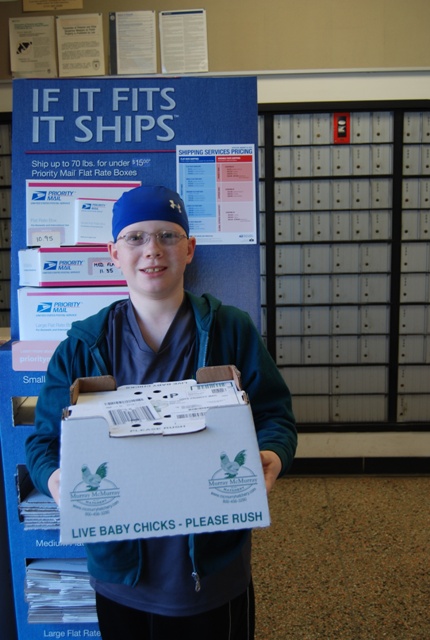
The babies are here! Last Monday at 7am, the post office called to say our chicks had arrived! My youngest son and I quickly scrambled and got out the door. As soon as we opened the door to the post office we could hear the peeping. The postal worker handed us a small box crammed with 28 baby chicks (see pic). They were only a day old.

Now, I certainly don’t need 28 chicks. We have 10 laying hens. We like to have about 18 hens – that’s the  magic number to provide us and our neighbor-customers with eggs, and still leaves a few left over to give as gifts. Several of our older hens are not laying so much and some weeks we barely have enough eggs for us. Still, we don’t need 28 chicks.

Problem is, when you order chicks through the mail, the minimum order is 25 chicks. I’m guessing this is the baseline of body mass to ensure survival. When you cram 25 newborn chicks into a shoebox, they keep each other warm. Two of the extras happened because of the lengthy e-chat I had with a nice man at the hatchery in Iowa. He threw them in because I filled up an afternoon with my questions. Guess there's not much excitement at a hatchery in Iowa in the middle of February. The bonus chick was a surprise. “Look mom – they gave us an extra chick!” The identity and sex of the extra chicks is a mystery that will unfold this spring, but so help me, if that nice man gave me any roosters – it’ll be the last e-chat we ever have!

We brought the chicks home and set them up in a box in the garage with heat lamps, food, and water. It is very distracting, and in fact this post is late and of no practical use because of my frequent visits to the little darlings in the garage. They only stay cute for a very short while and then they become large, noisy, garden-wrecking mobs that make me crazy-mad, but in a good way.

Have you ever thought of keeping your own chickens? Here are some good reasons –

  1. They are excellent for pest control, eating the grubs and larvae all year long that would have become bothersome insects like Japanese beetles. Ticks are one of their very favorite delicacies. We’ve discovered that they also love stink bugs! We gather up the ones in the house with a shop vac and then empty the bag into the chicken pen. You should see those hens line up when they see my husband coming with the shop vac! I tell you if chickens could fly they would take care of our stink bug problem!
  2. A young laying hen will produce nearly one egg a day for you! As they get older, their laying slows, but you’ll still get plenty of eggs for nearly five years from a single hen! If you’ve never had fresh eggs – you may not be appreciating this fact as much as you should. There is a BIG taste difference between a fresh egg and one from the store (which is most likely a month or more old)
  3. Chickens make great pets. Really. They each have a personality. They provide endless hours of entertainment. If you handle them plenty when they are little, you can continue to handle them when they are older. My daughter has walked two of our chickens in parades (on a leash!). They become very attached to the person who feeds them (that would mostly be me). When I am outside, they follow me around as I do my chores. It always puts a smile on my face when I turn around to see 30 chickens racing down the hill after me.
  4. Chickens will eat all your table scraps. We stay away from meat, though, because we want to keep our girls vegetarians. They don’t like tropical fruit, but just about anything else, they’ll gobble up.
Here’s the answers to the most common protests that arise from reluctant spouses when you propose getting chickens:

  1. They’re noisy. Actually, no, they aren’t, unless you get a rooster and then, well, it’s a nice farmyard sound. You don’t need a rooster, though. Like most females they produce eggs, whether there’s anyone around to fertilize them or not. Our eggs are fertilized thanks to all the hanky panky going on in our yard, but roosters aren’t necessary to produce eggs. Occasionally a hen will make an announcement when she’s laid an egg she’s particularly proud of, but the noise isn’t any louder than your kids or dogs playing in the yard.
  2. They’re dirty. Unless your chicken yard is muddy (as ours can be), they’re actually pretty clean animals. Of course, after handling them you’ll want to wash your hands, just like you would after handling your cat or dog.
  3. They’re a lot of work. Really, there’s very little work, much less than there is with a cat or dog (or rodent in a smelly cage). You don’t have to clean up after them, except to sweep out the roosting house now and again and they put themselves to bed each night. Chicken waterers and feeders usually hold a few days worth of feed, so you don’t even need a petsitter when you go away.
  4. Our neighborhood/town/county won’t let us have them. This isn’t always the case. I know lots of people who keep them in their backyards in very swanky neighborhoods. As mentioned above, they aren’t noisy or messy, so most people won’t even know you have them. Check with the powers that be, though, before launching this endeavor.
  5. They’re expensive. Not really. Expense is relative. All you need to keep a few chickens is an enclosure like a dog kennel and a box/cabinet of some kind for them to roost in. My husband built ours mostly out of scrap lumber. We built a separate laying house because we have so many, but it’s not necessary. Baby peeps are inexpensive - $2-$4 each depending on the breed. A 50lb bag of chicken feed feeds my girls for nearly a month for about $13, so figure you’ll spend a lot less on yours, especially if you supplement with table scraps, stale cereal, and leftover lunch crusts.
Hope this inspires you to consider keeping a few chickens yourself. If your living arrangement won’t allow, maybe you have a friend or relative who would go in on it with you. There are so many rewards in chicken keeping – amazing eggs, stellar fertilizer (chicken poop is premium fertilizer for your gardens), endless entertainment, and surprising life lessons about society, animal instincts, responsibility, and the pecking order.

Here are a few resources to get you started:

Backyard Chickens
McMurray Hatchery

Past posts:
I’d write more, but I’m missing so much action out there in the peeps’ pen, so I gotta go. They grow up so fast. Only a week old and they’re already sprouting feathers on their wings!

Thursday, March 1, 2012

Eating the 1%

I have two bird carcasses in my freezer. Well, actually, they don’t have feathers or heads anymore. They are the result of my husband and I attempting to put our knife where our mouths are and be responsible for the food we eat. I’ve said time and again that if we eat meat, we ought to not only know where it comes from but be prepared to kill it ourselves. Most people shudder at the thought. I do too. But it is the very fact that we are shielded from the actual killing of the animals we eat that makes it so easy to turn our heads at the atrocities that are going on this very second in the meat industry.

The beef you eat comes from cows that are spending their abnormally short lifetimes standing in their own manure, eating food that their bodies were never meant to eat, and being pumped full of antibiotics to keep them from getting sick from that very food and those conditions. Makes NO sense. Cows are meant to eat grass, wander in herds, and yes, be eaten eventually.

Chicken in a pot (on the porch)
The chicken and eggs you eat come from chickens that are living in near darkness, crowded in to spaces so close they can’t turn around, let alone spread their wings, take dirt baths, or peck the ground for grubs. I love watching the antics of my own chickens. Watching them streaking (in their own waddly way) from tree to bush to barn as if they are under fire amuses me to no end. The grand chase and battles that ensue when one pulls up an earthworm from the garden are an animal reenactment of my kids with the last cookie in the jar. They curiously peck anything new, like the football abandoned in the yard or the freshly carved jack-o-lantern on the porch. These are chickens in a “natural” habitat. While they may be exceedingly dumb animals, I do believe they are smart enough to know they are miserable in a typical industry chicken house.

The bacon you eat comes from pigs that must have their trademark curly tails “docked” so they won’t be bitten off by the other pigs crowded together with them in their holding pens for their brief time on earth (the industry has “progressed” to be able to get a piglet from birth to slaughter in just 4 months). They never have the opportunity to root or wander or play.

I suppose it comes down to how you perceive animals. Do you think they are people in furry suits, or are they unintelligent creatures whose only purpose on earth is to provide food for us? I’m somewhere in the middle of that equation. Why is it we eat pigs, but not dogs? Pigs are supposed to be more intelligent and, at least when they are little, they are equally cute. Pot Belly pigs aren’t eaten, but I assume they make excellent bacon.

I’m a horse owner and have provided foster care for horses that have been saved from slaughter by a local horse rescue. I’m kind of ambivalent about my feelings on this. Certainly, once these horses come to live with me I’m horrified that they almost ended up on someone’s dinner table. But in context, I suppose I don’t have a huge issue with the slaughter of horses for meat and whatever else it is they do with them AS LONG AS they are treated kindly during the process. Heartless, I know. I have horsey friends who will probably challenge me on this.

I do believe animals are intelligent (some more than others, my dog Gracie is just about the dumbest dog I’ve encountered and I’ve yet to meet an animal dumber than a chicken). So the idea that animals don’t really mind the harsh conditions prior to slaughter seems misguided. Raising animals in cruel conditions in order improve profit margins is a crime and I don’t buy meat that has been produced in those conditions.

But…… what about meat that has been produced in happy, healthy conditions? My chickens, for instance. The three roosters we butchered last fall spent the summer digging up grubs, chasing the hens, and lounging in the shade. For a chicken headed for slaughter they were in the 1%. But when it came time to kill them, it was so emotionally stressful that we let the fourth rooster go (ironically he was eaten that night by a fox) rather than put ourselves through it.

I don’t know how many emotions an animal “feels”, but I’m certain they feel pain and they experience fear (as the knowledge that they are about to feel pain). We tried to make it as quick and painless as possible, and in our fumbling efforts we were not as quick as we might have been if we had more experience. So these three roosters lived a good, short life and were killed quickly and humanely. And still two carcasses sit in my freezer. This is because I cooked the first one while he was still fresh and made him in to chicken and cheese enchiladas. And then choked on every bite.

I have to wonder if the people who live in slaughter houses ever eat meat. Maybe they can disassociate themselves from their work. Maybe they put on the blinders, much as the rest of us do, and buy the valu-pack at Wal-Mart without a second thought.

I still think that if you eat meat, you ought to be able to hunt and/or butcher the animal. We owe the animal that much. We need to respect the life that was given for us. And we should respect it enough to demand that it is treated humanely before it becomes our dinner.

The meat producers would have us believe that the only way to provide enough meat for the growing appetite of this country is to raise it nose-to-tail in a stockyard and feed it corn. But that is a lie. Raising animals in mass production only ensures that the prices stay low, the meat companies make lots of money, immense amounts of oil are wasted (growing and transporting corn), and the pharmaceutical companies get rich selling their antibiotics. If we took all the land that we use to raise feed corn and plow it under for grass, there would be plenty of space to raise enough meat. It might require a little more effort and sure, it might cost a little more (although I’d like to do the cost-analysis when you compare the real cost of growing corn and making the chemicals and antibiotics versus just turning a cow loose on grass). Heck, a change like that might bring back the cowboys (I’m all for cowboys).

Chickens don’t need nearly the amount of space as a cow, so changing that industry is even simpler. But again, it might raise the cost of your mcnuggets and reduce the profit margins of then poultry manufacturers.

Because I’m rambling, I won’t even go in to the difference in the nutrient value of meat raised on the diet it was designed to eat. But there’s that too.

I’m working up the nerve to cook another one of our chickens. I’m hoping enough time has passed that the images of the actual killing will have receded far enough in my mind to keep my throat from closing up.

Before you ask, yes, I’m well aware of the hypocrisy surrounding my choice to eat meat. Believe me, it weighs on my heart. I just wish it weighed on the hearts of the rest of the people with the power to bring change.

There is hope. McDonald’s, which purchases over 21 billion dollars worth of pork each year, recently informed suppliers that they will have to remove the “crates” they use tocontain pregnant sows. These crates keep the sows from ever even turning around in their lifetime of producing mass quantities of piglets. I would think confinement like this of such an intelligent animal would lead to mad pig disease. At any rate, this move will affect the entire industry. Finally McDonald’s does something we can be proud of. Let’s hope they take a look at the beef and poultry industries next – now that could change the world.

Wednesday, October 5, 2011

Free To A Good Home: One Rooster (maybe two)

The thing about chicks is they grow up. (Guess the same could be said about having babies or puppies or kittens) They don’t stay tiny and cute and manageable for long. Soon they are big and awkward and making all kinds of noise. Our seven little chicks that hatched out last Memorial Day are now chickens. Which isn’t necessarily a bad thing, except some of them, or at least one of them, is a rooster. I know this for certain because of the crowing. It’s time to put the new hens in with all the old hens, but what to do with the rooster? Surely if I toss little rooster-boy (he actually has a name the kids have given him, but I can’t ever keep them straight) in with the big roosters, I could get sited for cock-fighting. Although, I have no spare affection to shower on any rooster, and the extra cash from side bets might help me buy the new breadmaker I need, I really can’t bring myself to do that.


Instead, I’m investigating butchers. As much as I like to think I’m a farm girl and for as much as I can handle the realities of the animal kingdom, I can’t quite bring myself to take a life. I have no problem with taking the little crowing, strutting life to someone else for the killing, but I just can’t do it myself. So I’ve been making some inquiries. The butchers say, “Oh, it’s easy, you can do it.” I’ve had two very nice gentlemen carefully explain exactly what I need to do. Simple, kill ‘em, drain em’, pull the insides out (ew), boil ‘em, and the feathers come right off. Simple. Uh huh.

I need a farmer friend to volunteer his services. Another neighbor suggested I just take the rooster up in the woods away from the house and turn him loose for the foxes. This also seems cruel and irresponsible. What if the rooster finds his way to one of the nice 4 bedroom-2 ½ bath colonials nearby filled with pleasant people recently transplanted from the city? Will they trace it back to me? Is there a law against rooster-abandonment?

As I write this I can hear the little boy rooster crowing away and for every effort he makes, the big rooster yells back even louder. They’ve got a real call and response going, only I don’t think the message is anything like what you’d hear in church.

I’m giving myself until next weekend to make a decision. Then I’m going to put on my big-girl panties and take care of this situation. My ancestors did this. And really, all of us who eat meat should be able to do this. We’re hypocrites if we can’t, right?

First, I have to determine how many roosters I really have. Determining chicken sex is not as simple as you might think. There are two other young chickens in with rooster-boy who look suspicious. They have longer tail feathers and small attitudes. But they haven’t let loose with a crow yet. I don’t know if they’re intimidated by the guy already doing all that crowing, or if they haven’t figured it out yet, or if maybe (hopefully) they’re actually hens in rooster drag. I do want to be certain who I’m killing before I start killing.

Next spring when my hens start all their brooding nonsense, I promise I won’t be such a softy. There is no reason they need to hatch chicks. The Achterberg farm is a small China in reverse – only one male allowed in the chicken pen. The rest, well, the rest are going to be eliminated by someone. Maybe me. We’ll see. I’ll keep you posted. Meanwhile, I welcome your chicken butchering suggestions and assistance. Free To A Good, oh heck, ANY Home: One rooster.

Thursday, May 26, 2011

Parenthood According to Poultry

WARNING: This post is much too long and if you don’t really care much for chickens or mamas, you can skip it. I won’t be offended. Heck, I’ll never know. But if you linger over the nature channel, or struggle with your own ideas of motherhood, this one might be right up your alley.

Lesson one – You can’t stop motherhood.

This spring several of my chickens became mothers. Witnessing their adventures has been a privilege and a lesson. It’s also made it apparent why it’s necessary for chickens to lay an egg nearly every day to ensure the species’ survival.

Way back in February, when I was cursing the cold and fumbling my way through the barn in the near dark trying to find the light switch, my hand fell upon something feathered. Now, all things feathered should have already made it back to the dorm by the dusk curfew so this was unexpected. One of the surprisingly consistent behaviors of chickens is that as soon as the sun begins to set, they will always find their way back to the hen house for the night. So when I come flying up the hill in my pajamas at 10pm, they are all there quietly cooing on their perches only a little indignant that someone forgot to shut the door on the cold night.

I finally managed to locate the light switch and was shocked to see one of my Buff Orpington hens perched in the hay bales. I was even more shocked when I attempted to pick her up to move her to the hen house and she puffed up, bristled her feathers, and started screaming at me like a junkyard dog protecting a bucket of fried chicken. My first reaction was to jump back and put my hands up to show that I was unarmed (or maybe to be certain that I still had my fingers). Then I remembered that I’m the person and this is a small, relatively brainless bird. Plus I was wearing gloves. So I swooped in once more, ignored her protests and her sad attempts to remove my fingers and hauled her to the hen house. I retrieved the eggs she had been protecting and went about my chores.

Everything I’ve read says that the “broodiness” has been bred out of our modern chickens. So I felt fairly confident that this hen was simply confused, until we repeated this little scene every night for a week. To my children’s protests, I simply said, “We don’t need any more chickens unless these are chickens we raise for the dinner table.” That shut them up. And soon the hen quit her attempts at motherhood, or so I thought. A few nights later when I was moving some hay bales, I caught site of my would-be mother hen hiding back between the bales and the walls. This time to remove her I was forced to squeeze myself between the wall of hay and the nasty cob-web covered side of the barn. When I bent down to pick her up, my face was way too close to her fussing beak. I’ve fed this hen for two years, raised her from a peep, but I’m fairly sure she would have taken my eyes out if I’d gotten much closer. I considered moving the hay, but it was stacked six bales high and it was late. So, that’s how “Jules” got to live her dream. Because I’m the chicken.

I looked up “broodiness” in my chicken-keeping bible (Storeys Guide to Raising Chickens) and discovered that while most domestic chickens no longer have the urge to brood, occasionally a Buff Orpington hen will and sometimes she is even be successful. Huh.

Jules sat on her eggs faithfully as the hay bales slowly receded. Not being sure exactly when she began her sit-fest, I wasn’t sure when the eggs might hatch. It takes 21 days. I didn’t know how many eggs she was sitting on and I didn’t know if she knew what she was doing. It seemed pretty cold for an egg to be sitting on the ground. Plus the barn flooded during that time and I was too distracted with getting everything else to high ground, I forgot about Jules.

When I was pretty sure it had been more than three weeks and enough bales were eaten that I was able to reach her, I donned the gloves and picked her up. Much to my shock she was sitting on over 30 eggs. And I knew they weren’t all her eggs because there were brown, blue, white, and green eggs. Obviously, Jules was ready to raise everybody’s babies. When the other hens were out during the day, they must have been laying them next to Jules and letting her claim them. I didn’t have the heart to tell Jules that most of the eggs lying near the outer edges were ice cold.

That day we moved her to her own private box (the old pack-n-play). I selected six eggs that seemed warm and built her a small nest out of hay and shavings. She settled right in after lecturing me a bit to stay back. I had to admire this little hen’s determination to become a mamma. She was bucking her breeding, ignorance, and my efforts to deter her. And then one day, in addition to Jules nasty warnings, I also heard a little “peep”. A chick was born! There was much celebrating! And of course I posted her picture on Facebook. I’m glad Jules has a bird brain and probably doesn’t realize that this chick is obviously an Arucana chick and not a Buff Orpington, like her. A few days later a nearly identical chick popped out. And that was enough for Jules. She abandoned the remaining eggs and fretted over her two babes.

Lesson Two: Motherhood is contagious.

About two weeks in to the sitting project, another hen set up shop high in the bales. This was another of my Buff Orpington hens, so I knew better than to fight her on this. I barricaded her in with more bales hoping to deter the other hens from dropping their potential off-spring on her but soon discovered it wasn’t working. Her egg pile quickly rose to 15. So my husband and I “candled” her eggs. Candling is when you shine a light through an egg so you can see what’s inside. It’s no ultra-sound, but we were able to tell easily which eggs had a chick-in-progress and which were duds. My roosters are busy boys, but apparently they aren’t servicing each and every hen. So we pulled out the hot eggs and set this hen (“Treat”) up in her own digs just like Jules. Treat hatched her one and only chick about a week after Jules. Even though she sat faithfully, one day the stench of rotting eggs was so bad, I had to ditch all the remaining eggs and convince her that one chick is plenty.

My oldest son named the lone chick “Not-a-Rooster”, never even considering my suggestions of Ranger or Hans (as in Hans solo). He stuck with his choice, reasoning that this way maybe the chick would have better odds of survival since I (being the “meanest mother in the world”) had already declared that we had plenty of roosters and if any of these chicks was a rooster, he was going, one way or another.

When the chicks got a little older we let the two hens and their chicks out and delighted in watching them running around together. The two moms shared mothering duties and some nights when I would go up to the barn to put them away, I’d find all three chicks under one hen and no chicks under the other.

Not long after we began letting the chicks and moms run loose, I found a hen in the chicken pen sitting on eggs in the laying house. I guess seeing the other hens with their chicks was too much for her. I wasn’t too worried because this hen was a Jersey Giant and the book says that Jersey Giants are not good brooders, “rarely able to successfully hatch”. Good news for us. I confidently removed the would-be Mama from her egg box each night and shoved her back in the hen house with the others, apologizing profusely and grateful that she kept her beak in check.

I did this for two weeks straight. And then I began to worry about this hen’s psyche. What if she really, really wanted to be a mama? What if she would never stop sitting on eggs until I finally let her fulfill her destiny? What if she was really a Buff Orpington trapped inside a Jersey Giant? The two mama hens and their brood had moved in to the same pack-n-play, so I had an extra box. And now that we had three chicks, what’s a few more? I’m becoming soft. So now we have another hen sitting on eggs in a pack-n-play in our barn. She’s due on Memorial Day.

And that’s not the end of the story. About the time that I moved “Monty” to her new digs, “Python”, another black Jersey Giant began a campaign of her own. It’s been a week now of pulling this hen off her eggs every night. I’m torn. I feel the injustice that must tear at this hen’s heart (or it would if she had a brain that worked like that). How can I allow three other hens to realize their dreams of becoming mothers, and deny her? Probably I can’t, but right now there just isn’t an available pack-n-play.

Lesson Three: Some mothers are better than others.

Sad, but true. Some of us are just not cut out to be mothers. That’s what Jules figured out about two weeks in to the shared motherhood with Treat. One night I was late getting up to the barn to put away the mamas and babies. Normally at night they settle down in the old nest Jules built way back when this odyssey started. After dusk, I move them to the pack-n-play and cover it to protect them from any stray foxes or cats that get the wrong idea. But on this night I found only one hen. All the chicks were accounted for, but only one Mama. I looked everywhere, but no Jules. The only answer could be that a fox had gotten her. I imagined her sacrificing her life so that the others could escape. There was a real Lassie feel to my fantasy, but alas, no Lassie had come to the rescue.

In the morning, I sadly told the kids. Being kids (or maybe being my kids), they didn’t believe me. They slapped on their boots and went in search of Jules. Maybe she was trapped somewhere! They held out hope. And in just a few minutes they arrived back at the house triumphant! They’d found Jules! She was in the chicken yard with the other hens. Apparently, this motherhood gig wasn’t for her, so she hopped the fence and rejoined the single life, leaving Treat to deal with her two chicks. Oh, I laughed over that one. And now I remind the kids of Jules’ chicken run when they are pushing me to the brink.

Lesson Number Four: Some mothers will sacrifice all for their babies.

This was the saddest lesson for all of us. This past weekend, my husband and I were away on a rare weekend without kids. My parents had kid rustling duties. I had divvied up the barn duties and the dog duties and the cat duties, and yet it was still my mother who discovered late Saturday night that there were three chicks in the barn, but no Mama Treat. And in the morning, she was still gone.

When we got home I sent my husband to find the body. We both knew what had most likely happened. We have an old dog, a good dog, who is also a foxhound. She can’t help herself. We were fairly sure if the mama was gone and the babies were there, it wasn’t the act of a fox because a fox would have eaten those babies for dessert. No, this had to have been our old dog. And sure enough the evidence was under the deck. I lectured her as best I could, but really, she can’t help herself. Most likely, the babies had wandered in to dog territory and Mama Treat had put herself on the line between danger and safety. I’m certain she stood her ground to that huge, bumbling dog who kills simply for sport. Poor Treat. What a good Mama.

We knew better than to ask Jules to step back in, she’s moved on. So the babies are settled in to the chicken tractor until they are large enough to join the rest of the flock (except for Not-a-Rooster who really is a rooster and will be moving on to greener pastures hopefully at a neighbor’s farm).

I feel more attached to my girls now than ever. We are kindred spirits of sorts. I remember when I gave birth to my first child feeling very primal and at one with nature. As humans we tend to project our own experiences of motherhood on the animals around us. Animals do motherhood in a million ways, but some of their behaviors are very human.

Sadly, it does seem that motherhood is unstoppable and it can be contagious. Some people jump in to motherhood without serious consideration. Societal expectations have been ironed on to their hearts just like animal instincts, or maybe they do it because “everyone else” is doing it. There are others who would do anything to become mothers – suffering all kinds of indignities and hardships.

Motherhood is not for the faint of heart. There are some days I truly do want to fly the coop and rejoin the single life, but deep down I know I would lay down my life if it meant the safety of my babies. So maybe lesson five is: Everybody does motherhood differently. Expectations and comparisons are a dangerous game. We never truly know what we are capable of until we let our children (or our chickens) teach us.

Wednesday, July 14, 2010

A 13-year-old's Thoughts on Organic Food

I asked my 13-year-old son to write about organic food for this blog. Being 13, he gets a little side-tracked, but I think he has some helpful advice to share. His plan this summer was to “do nothing” – no camps, no sports, no job. Asking him to write this post was an interruption in his do nothing summer, so I suppose I’m lucky to get four paragraphs. When he first proposed his do nothing summer, I worried that I was raising a slacker, but upon further reflection I realized there will be very little opportunity for him to do nothing in this life, so this summer is our gift to him. Following his lead, I’m trying to carve out a little do nothing time this summer too. You’ve probably noticed my posts have been fewer and further between. But maybe you’re finding some do nothing time of your own and haven’t been following closely. Let’s hope that’s the case and if it isn’t, well, maybe you need to find a little do nothing time of your own. Enjoy.

Some Advice on Convincing Kids to Eat Organic Food

by Brady Achterberg

It seems that everything invented over the last one hundred years was something that we were better off without. TV and video games are taking up time that we would spend exercising. Cars smog up the atmosphere and cause global warming. Cell phones and microwaves may be radioactive, computers cause geekiness, Velcro takes away people’s ability to tie shoes, plastic makes landfills, and robots take up job spaces. And non-organic food… well, everyone reading this blog knows about non-organic food by now.

One of the things that I’ve really gotten into over the last three years is chickens. I am obsessed with chickens. (When you have them, you become obsessed with them; there’s no way around it.) Chickens really helped me (and maybe my little brother Ian, too) become more familiar with organic food, and now, curses, I can’t stand the taste of normal chemical-addled hot dogs and milk. But before we had chickens, I absolutely refused to eat natural foods, I boycotted maple syrup, and I went out of my way to eat “normal” food. I don’t actually know whether this has to do with chickens or not, because my little sister is about my age when I hated organic food and she’s of the same mindset of me at that time, but I would advise any person who’s trying to get their kids to eat organic (and I’m told that’s why I’m writing this post) to get some kind of farm animal to show around. Not as food, in case you already have plenty like that, but as a pet. It worked for me.

For those of you in cities, where you can’t legally own a chicken, I can’t help much, but I would suggest getting organic food without telling anyone that it’s organic. Sometimes kids can taste the difference (maple syrup, cheese crackers, most kinds of milk, hot dogs), but many times they can’t, and by the time they realize what they’re eating, they’re used to it. Also, if they are really, really insistent about a certain kind of food, then don’t bother shoving the organic version down their throats. Lastly, give them foods that taste good to them, and the kid’s definition of “good” is adult-speak for “simple:” in other words, they like stuff that has one taste, has a normal texture, is appealing in the visual sense, and has a simple taste.

So that’s about all the advice that I could give someone trying to get a kid to eat organic, but I have to say that I’m just saying what worked for me; there’s not necessarily any guarantee it will work for you. Also, to any kids reading this blog: I’m sorry I betrayed this information to the enemy. I had no other choice.

Thursday, October 8, 2009

My Hens Lay Golden Eggs!

My hens lay golden eggs! I hadn’t appreciated this fact before, but now I do. The eggs that I collect each night are free range, cage free, hormone-free, organic (albeit not certified), humane (again, not certified), free-roaming, vegetarian-fed, natural, fertile, and even Omega-3 Enriched! So how much do you think they might go for in a grocery store?? See? They’re golden. This picture is a collection of some of the variations we've collected. The tiny eggs are from chickens just starting to lay eggs and the jumbo one is from our over-acheiver hen.

Egg cartons have a lot of terms on them. A friend sent me an e-mail with some definitions and as I read it, I thought two things – 1) my eggs are valuable and 2) my hens have it good. I do remember the days of standing in front of the egg selection at the grocery store contemplating the labels. It was really hard to decide what was worth paying more for. Certified Humane seemed like a good thing, but Free-Roaming might be better. Are Fertile eggs better for you? And of course I was looking for organic. Well, here are some definitions that might help clear it up or just might confuse you more.

Certified Organic: The birds are uncaged inside barns or warehouses, and are required to have outdoor access (although there have been concerns about lax enforcement, with some large-scale producers not providing birds meaningful access to the outdoors). They are fed an organic, all-vegetarian diet free of antibiotics and pesticides, as required by the U.S. Department of Agriculture's National Organic Program. Debeaking and forced molting through starvation are permitted. Compliance is verified through third-party auditing.

Although it sounds like some less-savory characters could game this system, certified organic is probably a good thing, unless you’re a hen. While, I don’t really know what forced molting through starvation is, I’m guessing it means withholding food so that your birds lose all their feathers. I’m not sure why you’d want to do this, unless it’s to keep the molting to a schedule. Hens don’t lay eggs while they are molting. My hens seem to be taking turns with the molting thing, so it’s not an issue for us. My neighbor’s hens all molted at once, so we gave her eggs. Debeaking means to cut off the sharp end of the hen’s beak so she can’t hurt anyone else. When birds are crammed together in close quarters they may fight, just like my kids do in the car. Debeaking keeps them from drawing blood. If your hen is bleeding it’s a really bad thing. I’ve never seen it, but all the books say that the other hens will attack her and eventually kill her. Chickens don’t have any morals, apparently. So organic is all well and good if you don’t mind your chickens beakless and subjected to starvation from time to time.

Free-Range: While the USDA has defined the meaning of "free-range" for some poultry products, there are no standards in "free-range" egg production. Typically, free-range egg-laying hens are uncaged inside barns or warehouses and have some degree of outdoor access – it might be a concrete slab or a grassy pasture. They can engage in many natural behaviors such as nesting and foraging. However, there is no information on stocking density, the frequency or duration of outdoor access, or the quality of the land accessible to the birds. There is no information regarding what the birds can be fed. Because of their more relaxed living conditions, these hens produce fewer eggs, making those eggs more costly. Debeaking and forced molting through starvation may be permitted. There is no third-party auditing. Free range eggs generally have the same nutritional content as other eggs.

I used to think my girls (and boys) are only considered free-ranged part of the year (the non-vegetable garden season), but apparently because they have access to their outdoor pen they qualify as free-ranged all year, even when they aren’t pooping on my porch and digging up my mulch. Seems to me, free-range could mean a lot of things and you shouldn’t take the carton’s word for it. It would be helpful if you could talk to the farmer or if there was more information offered beyond the label. At my natural grocery store, there are pictures of the hens pinned up along the coolers where the eggs are, so you can see from whence they came. The hens are outside in the grass and look very happy.

Certified Humane: The birds are uncaged inside barns or warehouses, but may be kept indoors at all times. They must be able to perform natural behaviors such as nesting, perching, and dust bathing. There are requirements for stocking density and number of perches and nesting boxes. Forced molting through starvation is prohibited, but debeaking is allowed. Compliance is verified through third-party auditing. Certified Humane is a program of Humane Farm Animal Care.

Debeaking doesn’t seem very humane to me. Maybe it’s humane to the birds around you, but if you’re the one having her beak cut off, that just doesn’t sound very pleasant. Again, this seems like a fuzzy definition. There are very few animals, and pretty much no farm animals, I can think of who are happy living inside all the time. But at least they must be able to nest and perch and take their dust baths. For those of you who are curious, chickens have this crazy need to roll in dirt. They actually seek it out, dig a hole and then lay in it and roll around. Then they stand up and shake out their tail feathers (ha! Another chicken phrase!) to get the dust out. The first time one of my hens did this I thought she was dying or grievously injured. I called my chicken-expert neighbor in alarm and she assured me this was a natural thing chickens do. Now I just mutter curses at them when I trip over freshly dug dust bathtubs in my run-in shed.

Cage-Free: As the term implies, hens laying eggs labeled as "cage-free" are uncaged inside barns or warehouses, but generally do not have access to the outdoors. They have the ability to engage in many of their natural behaviors such as walking, nesting, and spreading their wings. Debeaking and forced molting through starvation are permitted. There is no third-party auditing.

It’s good to be cage-free, but again without the blue sky up above you, what’s the point? And if you read carefully, they aren’t crammed in so tight they can’t spread their wings – lucky birds. But I didn’t see anything about dust baths, so cage-free girls might be a little nutso with no fresh air and no bathing. Plus, again with the debeaking and forced molting, not the life for me. My hens just don’t know how good they have it.

Free-Roaming: Also known as "free-range," the USDA has defined this claim for some poultry products, but there are no standards in "free-roaming" egg production. This essentially means the hens are cage-free. There is no third-party auditing.

Ditto, above notes on free-range.

United Egg Producers Certified: The overwhelming majority of the U.S. egg industry complies with this voluntary program, which permits routine cruel and inhumane factory farm practices. By 2008, hens laying these eggs will be afforded 67 square inches of cage space per bird, less area than a sheet of paper. The hens may be confined in restrictive, barren cages and limiting their ability to perform many of their natural behaviors, including perching, nesting, foraging or even spreading their wings. Compliance is verified through third-party auditing. Forced molting through starvation is prohibited, but debeaking is allowed. This is a program of the United Egg Producers.

Wow. I’m glad my eggs aren’t certified by the United Egg Producers. This might be a certification to avoid. It’s like Wal-Mart stamping a Mass Market Producers certification on their own products. The official certification makes you think it’s a good thing, but when the people doing the certifying are also making the profit it’s meaningless. No living thing should have to live the way most chickens do on traditional poultry farms. You can read about it in Omnivores Dilemma or watch it in Food, Inc. I know first-hand how stupid chickens are, but I also know they have personalities and display emotions like fear and anger. I even think they display joy when I arrive with a box of stale cereal or uneaten popcorn. I’m not a vegetarian and I plan to raise some chickens for meat this year. Still, I believe all living things are entitled to dignity and decency even if their ultimate purpose is to end up on my dinner table. (hmm – that should prompt some e-mail from a few vegetarians!)

Vegetarian-Fed: These birds are provided a more natural feed than that received by most laying hens. This term, like grass-fed, is not regulated by the USDA, so unless you know your supplier’s farming practices this label is largely meaningless.

OK, here’s my issue with this. My hens are fed a vegetarian diet. The feed I buy does not contain animal byproducts and I don’t feed them bacon, but they do eat bugs. Lots of them. And I’m sure that even a caged chicken reaches out and snags a fly or a gnat or a mosquitoe from time to time, so really, how can any chicken be a vegetarian??

Natural: Currently there is no legal definition of “natural” as it relates to food products. According to the U.S. Department of Agriculture any food that contains “no artificial ingredients or added color and are no more than minimally processed,” may be considered “natural.”

I’m sure you’re smart enough not to be fooled by that “natural” label by now.

Fertile: These are eggs that, when incubated, will develop into chicks. They are no more nutritious than other eggs and usually cost more. Usually fertile eggs are cage-free and come from hen houses where roosters roam as well, which some consumers believe is a more natural habitat. As for taste, it's negligible—once cooked, only a true egg aficionado would taste any difference.

What is a true egg aficionado? I think my eggs all taste great and I certainly couldn’t tell you which ones are fertile and which ones aren’t. There’s no visible difference, so don’t worry that you’re going to crack open a fertile egg and find a half-formed baby chick.

Omega-3 Enriched: Eggs carrying this label have a higher content of omega-3 fatty acids than other eggs. This is achieved by mixing flaxseed, a grain high in omega-3s, into the hen’s feed. Omega-3s are a type of unsaturated fatty acid essential for healthy human metabolism that the body cannot produce. This type of fatty acid is thought to benefit the cardiovascular system, reduce inflammation in the body, and reduce risk factors for chronic diseases, such as cancer, arthritis, and heart disease.

These eggs are probably worth paying more for. I buy flaxseed, which is expensive, and mix it in with my chicken feed. I’m always looking for more ways to get Omega-3’s in to my family.

Hormone-free: It may as well read "rip-off"! Because the use of hormones in poultry has been banned since the 1960s, all eggs are by law hormone-free. If a carton offers this claim alone, you're wasting your money if you pay extra for it.

Good to know, huh? We consumers sure are gullible.

Here’s a few more tidbits about eggs that were passed along to me:

Does Size Matter?Generally, egg size reflects the age of the hen: the older she is, the larger her egg. Breed, weight, and living conditions (such as heat, stress, overcrowding, or poor nutrition) can also affect size. Extra-large, large, and medium are the most common varieties, but you can also find jumbo, small, and peewee.
Egg grades—which include AA, A, and B—refer to the ratio and quality of white to yolk and to the condition of the shell. Grade AA and A eggs have thicker whites; firmer, more round yolks; and cleaner shells than Grade Bs. Nutritionally speaking, however, eggs are the same regardless of grade. So if you're paying up for a bigger egg, you're buying size and nothing more.

Store Smart—and Save!Properly refrigerated, eggs can keep up to one month beyond the "best before" date printed on carton. Keep them stored inside the carton, securely fastened. Eggshells have thousands of tiny pores; never store eggs in an open basket or box, as they will absorb odors from other foods. Also, though it may sound counterintuitive, don't keep your eggs in the special egg unit on the inside door of your refrigerator. Though it may be handy, it actually prevents proper airflow to your eggs.

Here’s what I know about size and storage –
The really big eggs are sometimes double yokers, which is cool. Egg comes in all kinds of colors other than white and brown. Our Aracana chickens lay green and blue eggs. Really, they do. Our Bard Rock chickens lay light brown eggs just like you see in the grocery store, and our Rhode Island Reds lay beautiful deep brown eggs that are sometimes speckled. But the shades of the eggs vary day to day and I don’t know if that has to do with diet, temperature, or just their mood that day. It is amazing to see the variety.

I’ve kept fresh eggs in the refrigerator for 3-4 months and they are still fine. If an egg goes bad you will know it before you crack it. Remember all those pores mentioned above, a rotten egg will stink up your entire fridge, so don’t ever throw away an egg because it might be bad – take a whiff. Other chicken farmers have taught me that a fresh egg just plucked from the nest will keep on my counter for three weeks. Unless it’s really hot, I leave our family eggs in a bowl on my counter – they look nice and truly they’ve never gone bad.

I know you’re thinking – it’s not the rotten egg I’m worried about, it’s the one with salmonella. Very few (I couldn’t find any) cases of salmonella poisoning come from a person eating a homegrown egg. Here’s what Consumer Reports had to say about homegrown eggs:

While eggs are indeed a leading cause of salmonella poisoning, the bacteria that causes the infection may be more likely to breed in the cramped confines of factory farms than in free-range, backyard chicken runs. And people tend to eat home grown eggs when they’re fresher, and thus less likely to be contaminated….

And here’s some information from Consumer Reports for those of you concerned about eggs and your health. (I have to take this moment to note that my husband has genetically high cholesterol and in the past year while he’s eaten more eggs than ever before, his cholesterol has actually gone down! My money’s on the huge amounts of flax seed meal I’m sneaking in to his food, but still!)
But in truth, all eggs can be good nutritional choices, containing not only protein but also vitamin D and choline, a nutrient recently linked to a reduced risk of birth defects and possibly breast cancer. While eggs are relatively high in dietary cholesterol, most people can eat about six a week without worry. Even those of us with high cholesterol levels can safely consume them in moderation, as long as they watch out for other sources of cholesterol. And in early July, the Food and Drug Administration announced new rules aimed at reducing salmonella contamination in store-bought eggs.
Eggs can become contaminated when a laying hen is infected with
salmonella enteritidis and passes the bacteria to the egg before it is laid. If the egg is not refrigerated, the bacteria can grow inside the uncracked, whole egg. So the new rules place greater restrictions on large farms—those with 3,000 or more laying hens—to ensure the hens are raised in environs free of pests that can spread the bacteria, and that eggs are refrigerated when they’re stored and transported, to prevent the bacteria from growing.

Back to those pores – here’s something you should know. When an egg is laid it has a protective coating on it, called the “bloom”. The protective coating keeps bacteria from getting inside the egg while it is sitting in the hen house or on the counter. All eggs have it unless they have been scrubbed clean to look pretty at the grocery store. Some store bought eggs that have been cleaned are then given a sheer spray of mineral oil to protect them. That’s why they sometimes appear shiny. So next time you buy some eggs at the farmer’s market, you might ask if they’ve been washed off.

See why my eggs are golden?? You can have golden eggs too. Just about anyone can keep chickens, even those of you who live in suburbia or even the city. All you need is a large dog run and a “house” of some kind. Chickens are cheap and easy to keep and they pay for themselves. And you don’t need a noisy rooster to have eggs. (Just in case you were wondering. People ask me that all the time.) You only need roosters if you want to hatch more chickens. I wrote a whole week of posts during Chicken Week, March 2-6, 2009. Check out those posts or pick up a book on Chicken Keeping if you’re curious. One other reason to keep chickens – they make great pets. I don’t believe they are a common allergen. Kids have great fun with chickens. My daughter trained one of ours to walk on a leash (with a small dog harness). They can become very docile and friendly. And did I mention they are cheap? Our original chicks were just $3 a piece, but now they cost nothing to produce!

Sources:
The Humane Society of the United States. A Brief Guide to Egg Carton Labels and Their Relevance to Animal Welfare. March 2007.
E-mail forwarded to me from the AARP Buyer’s Guide
Consumer Reports.org, July 24, 2009
My own wealth of experience (or lack there of)

Friday, March 6, 2009

Chickens and Truth Telling

I promise this is the last of my chicken musings. I know I've got a bird problem, as evidenced by the shoe box I brought home from my children's school today. My mistake was volunteering in my daughter's classroom where they just hatched a bunch of chicks for their science unit on embrylogy. (Sorry honey, if you're reading this from China - what's three more?) I wrote this a few months back when I was wrestling with a question all parents must come to terms with at some point. Although, I’m betting most parents don’t have chickens (and dogs and Fed Ex men) that force their hand like this. Still, I think it’s universal.

How do I tell my children that the dog killed a chicken? Not a question most people are musing over. Although my subject matter is different, the issues are there for all parents. Do you tell the whole truth, the candy-coated truth, or a partial truth? Or, do you just not tell them at all? A chicken’s missing? I wonder what happened?

We have/had 14 chickens and one fox hound. The fox hound, Lucy, lives happily outside within the bounds of her invisible fence. The chickens, which lay organic, free-range eggs for us, live in and around their chicken pen and hen house. But sometimes they wander a little far a field, especially since we lost our rooster to a chicken hawk. They are leaderless and sometimes they forget the way home.

The Fed-Ex guy innocently drove up our driveway (too fast I am sure, but I wasn’t there to witness) and startled the dog, who startled the chickens who had wandered into the invisible fence land. Chickens aren’t that smart and they certainly aren’t that fast, so in their fluster one didn’t make it over the line fast enough and Lucy pounced. She shook it to death and then left it for a fox to cart away (which it must have since there is no evidence left). The only reason I know the exact order of events is that the Fed Ex guy happily relayed the episode the next day when he arrived with another delivery. He seemed impressed with my dog and not the least bit sympathetic to the chicken in question.

You have to understand that these aren’t just chickens. They are pets, individually named and marked with a colorful beaded anklet. We raised them in the kids’ old pack and play crib in our mudroom last spring. One of our chickens marched in the pet parade and won an award for originality. My daughter can tell you the personal habits and characteristics of each hen. Lou-Lou talks a lot and likes to be the center of the action. Mrs. Brutus lays the biggest eggs. Chicory likes to roost on the lawn mower. She knows these birds.

The kids will be home from school soon and I have to tell them something. They will notice a missing bird. How it got by them yesterday I don’t know except that it was raining and I was the one who closed the hen house without counting noses (beaks). I could easily blame a hawk again. I’m sure I would if the Fed Ex guy hadn’t given me the low down. I could say nothing, wait for them to come tell me a bird is missing, act dumb, and let them draw their own conclusions. But I am their mother. I expect the truth from them, so how can I not give them the truth? They will hate the dog for a day or two. It’s not her fault. She’s just doing what dogs do.

I guess it comes down to trust. I have to trust them to handle the truth – to understand that the dog was just being a dog, the chicken a chicken, and the Fed Ex man, the Fed Ex man. They deserve the truth from me and besides that I’m not a very convincing liar. The truth is always the safest bet. The truth will not come back to haunt you. I can only teach this to my children by living it myself. So that’s it, I will tell them the truth, trust them with it, (and then be sure to mention that the Fed Ex man was delivering our tickets to Disney World).

Thursday, March 5, 2009

More chicken musings

Raising chickens has brought to life the real meaning of the well worn phrases “pecking order”, “coming home to roost”, and most certainly about a “fox in the hen house”. Nearly every morning I’m counting my chickens and our birds chatter like a bunch of old hens. My children, and especially my husband, delight in discovering more and more of our common idioms that originated with chickens. We understand literally about getting your feathers ruffled and having something to crow about. By the way, roosters don’t need much to crow about. They crow not just in the morning but all day long whenever they are startled and many times for no apparent reason. There is much that is amusing and surprisingly, a lot that is beautiful, about raising chickens.

I love gathering the eggs. We attempted to convince our hens to lay their eggs in the hen house early in this process. We were very proud of ourselves when we managed to fool them in to laying their eggs in the cat litter boxes we’d provided. We planted plastic easter eggs filled with sand among the wood shavings that filled each box and in no time real eggs began appearing snuggled next to the fake ones. This worked just fine until the hens discovered the hay pile. They much prefer perching as high as they can hop/fly on the stacks of hay. They burrow little nests in the tops of bales and happily lay their eggs. Sometimes several hens will lay their eggs in the same “nest”. In the evening when I collect the eggs it is like an Easter egg hunt. All those stories about collecting the fresh eggs each morning were wrong – our chickens lay their eggs during the day, not the night. I love climbing over the bales searching for the hidden eggs. The hens move their nests periodically. They seem a bit affronted that someone is stealing their eggs. Every now and then they secure a really good spot and I miss their eggs for a few days. When this happens, soon all the chickens are laying in the same safe spot and this gives them away because I notice the drop in production and renew my efforts to find the missing eggs.

I have to wait to collect the eggs until the hens are already in their roosts for the night, otherwise I am followed by scolding birds as I search and gather. This makes me feel incredibly guilty and just a bit threatened. I look in to their angry faces, and imagine what they could do with their pointy beaks if they really lost their cool. I know if I were a hen and I’d worked to pop out what are increasingly becoming jumbo size eggs, I’d be pretty furious with the giant who kept stealing them. I’d begin to plan attacks on the said giant’s ankles at the very least.

Walking back to the house with my basket of eggs I always feel a little bit awed. Here is nature providing. A hundred years ago everyone kept chickens and it’s easy to see why. They eat scraps and bugs and grass and weeds, keep the ticks and grubs in check, and fertilize the gardens. And in return you get delicious, fresh eggs filled with protein and vitamins that sustain. Eggs are one of the few foods all three of my children will eat. Now that we have chickens I keep an egg carton of hard boiled eggs ready to go at all times. They make the perfect snack. And hopefully come summer we will have a few less Japanese beetles devouring my raspberries thanks to the chickens’ healthy appetite for grubs. It’s a win-win. Nature as it was intended to be.

As the winter marches on, the hay piles are shrinking (the ponies must be fed) and I worry where the girls will lay their eggs come spring. I can’t imagine them going back to the liter boxes after the adventures of laying on the hay pile. No doubt my egg hunting will continue far beyond Easter.

Wednesday, March 4, 2009

Free Range Life

This is part of an essay called Free Range Life that I wrote last summer. It’s just for fun, but if you’re considering chickens of your own, it’s another data point.

I knew we’d crossed some kind of line when my daughter brought a chicken to soccer practice. A real chicken. On a leash. She was rehearsing “Thing Two” (one of our most cooperative hens) for her turn in the Pet Parade the following weekend. A year ago chickens were just pictures in children’s stories at the library. Now, our property is cluttered with them.

Our chicken adventure began innocently enough we just wanted some cheap organic eggs. After talking with other chicken keepers in our area, factoring the foxes, hawks, and our own dog (who killed many of our neighbor’s free range chickens when they ranged in to her invisible fence area) and allowing for this expected attrition, we determined that we needed 10-12 chicks to end up with the right number of eggs for our family. Just like shopping at Target, when I went to the feed store to order the peeps, I came home with much more than was on my list. We ordered our “peeps” (one day old chicks) sexed - which means that they would all grow up to be hens. A few months later, we learned that sexing new chicks is an imprecise science as three out of eighteen of our peeps turned out to be roosters.

After hearing the story of how a neighbor lost 22 chickens in one night to a mink, my husband, engineer that he is, took it upon himself to build the most heavily fortified chicken coop in the county. Nothing is getting in to our hen house (unless someone forgets to go shut the door each night!)

Our herd of 18 chickens was slowly thinned (not due to any foxes in the hen house you can be sure!). We lost one chick early on when we first moved them outside. We’re not sure what the culprit was, but the dangers of life outside our mudroom heightened our attachment to our girls. We willingly gave away two roosters keeping the nicest one – Snowball – and ridding ourselves of the mean ones – Rocky and Brutus. Our children were much relieved when the roosters found homes with some local 4-Hers, rather than on someone’s dinner table. We did propose eating them ourselves, however, I’m afraid it would have put my children off chicken forever and the process itself seemed extremely feather-filled. As my fellow chicken keeper friend says, “I don’t eat anyone I know.”

We were happily down to 15 chickens when a real tragedy struck. Snowball disappeared. After looking for clues, making desperate phone calls, and conducting a search, it was determined that Snowball was taken by a hawk. I thought chicken hawks were Looney Tunes cartoon characters, but I was wrong. The very next day, my husband caught another hawk making an attempt on one of our hens. The commotion and a faster than expected hen, foiled the hawk’s plan, but now the threat was real. If we want to free range our chickens, there is not much we can do to defend them from hawks. For now, I keep one ear cocked for the telltale sound of a hawk (it sounds just like the eery squawking at the beginning of a scary movie) and sprint outside screaming and waving my arms at the first alarm. So far, I’ve definitely worried my cats and confused my chickens, but have yet to frighten off a hawk.

The loss of our rooster, Snowball, has had some other odd effects. The first morning without Snowball, the hens would not come out of the hen house. They just couldn’t figure out what to do if Snowball wasn’t there to lead them. I have to say, as a strong independent woman, I was disappointed. Do these girls really need a guy around to lead them? Apparently they need someone, and as it turns out that someone became me. They began following me. They even follow me back to the house and hang around on the porch waiting for me. Eventually they are lured away by the prospect of bugs and tomatoes in my garden, but as soon as I appear outside they come running to me. If you’ve never seen 14 chickens running top speed towards you, you’re really missing out. It is the funniest sight and completely endears me to them even though I’m sick of cleaning up chicken poop from my front stoop. When chickens run there is a side to side lurch much like you might imagine Fat Albert would have if Fat Albert ever ran. They pick up their feet extra high so as not to trip over them, kind of like walking in snow boots. It is comical to watch. Sometimes they even flap their wings like they might become airborne if they just could trip along faster. I’m a runner myself and some days when I’m jogging down the road before dawn and no one is watching, I try out their style and it makes me grin.

The training session on the soccer field was a bit of disaster. Much to my daughter’s frustration, the chicken would only go backwards on the leash. But she was undeterred and simply enlisted another more cooperative hen, Sunny. After a few more outings, Sunny did make it to the Pet Parade and she and my daughter won an award for originality. Sunny has resumed her normal life again amongst the girls. The egg production is still stuck at three a day, but I’ve been told the day is coming when we will have 14 eggs a day. I’m a little concerned about that so I’m hording egg cartons and making a mental list of all the people who will appreciate some fresh, organic, free-ranged-on-my-porch eggs.

Monday, March 2, 2009

It's Chicken Week!

This week is chicken week. I’ve been waiting to write about keeping chickens and organic eggs because I have too much to say and this blog is called kid-friendly organic life and not kid-friendly organic life with chickens. My hens (and those pesky roosters) are teaching me many things about chicken keeping, eggs, children, and life. So this week I’m going to post a whole bunch of information and some reflections on chickens. I’ll start with the scoop on keeping chickens. It’s really very simple, and in my opinion, much easier and certainly more profitable than keeping hamsters.

Keeping chickens is not difficult. If you have enough property, I encourage you to try it out. Even if you don't have much property I still encourage you to try it out. I know people who keep chickens in small pens in the city or even fancy neighborhoods. If you really want to do it, check your neighborhood code and find out what kinds of pets are legal. Chances are you can keep a chicken. They don’t require a ton of space and unless you have a rooster they don’t make much noise.

My husband jokes that the first egg we collected cost about $250 and each egg thereafter has been a little less expensive. Here is our breakdown:

Wood for hen house (we used lots of old junk lumber we had laying around plus an antique door my neighbor was throwing out) $75
Fencing (we use chicken wire stapled partly to some other fencing and partly hung on metal electric fence posts) $50
Electric water heater $60
Feeders $25
Peeps (1 day old chicks) $54 ($3 x 18)

Feeding the chickens costs a little more in the spring and summer when they are confined to their pen for 23 hours a day. We raised 18 peeps in three months on less than 2 bags of chick feed (the kind with no antibiotics added). Chicken feed costs $13 for a 50 pound bag. We use 2 bags a month when they are in the pen and less than a bag a month when they are being free ranged. We also feed them lots of table scraps. They love bread crusts, leftover pasta, cereal, snack food, cheese, eggs, old fruit, lettuce, and especially popcorn. If you’ve got kids in the house, you’ve got plenty of chicken feed leftover after every meal. Sometimes I buy the hens some bird seed as a special treat – they love the black oil sunflower seeds and will become ferocious in their battles to get to them.

Now here’s the best part. Most good laying hens lay an egg every day. At this point we give away all our extras, but I can see the wheels turning in my entrepreneur daughter and chief chicken keeper. I’ve been told by other chicken-keepers that fresh eggs that have just been collected will keep for three weeks at room temperature. We refrigerate ours immediately and they are good for at least 3 months. I mark the full containers with the date they were collected. Chickens will not lay as much in the winter. We had been led to believe they would not lay at all and so stockpiled nearly 14 dozen eggs, but our chickens never stopped. They did slow down to about ½ their rate, but that is still at least 6 every day. I’ve been told that you can also freeze eggs. We haven’t resorted to that yet, our freezer is pretty spoken for. I have cracked a frozen egg on an especially cold day and it looks really cool but cooks up just like an unfrozen one.

Fresh organic, free ranged eggs can cost up to $4.50 a dozen. My hens are already coming close to earning their keep and somewhere down the line they should be profitable too. But for now, just having them around for entertainment and enlightenment is good enough for me.

If you have specific questions about setting up your own chicken operation, please let me know. I’d be happy to answer what I can and/or get answers for you from the “chicken lady” who lives down the street. She knows everything about chickens and has fielded my stupidest questions with incredible kindness.