Showing posts with label organic eggs. Show all posts

Tuesday, April 10, 2012

Chicken Keeping, Anyone?

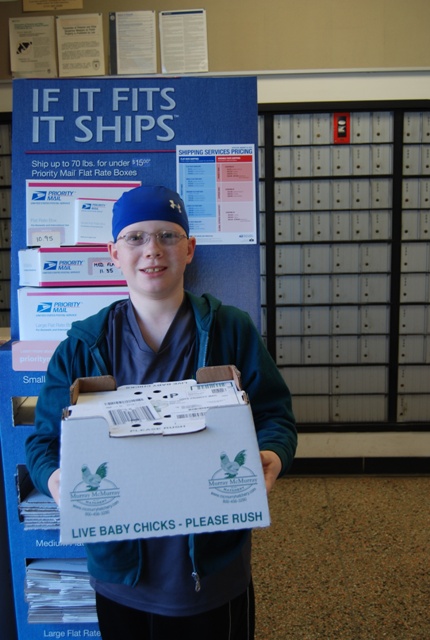
The babies are here! Last Monday at 7am, the post office called to say our chicks had arrived! My youngest son and I quickly scrambled and got out the door. As soon as we opened the door to the post office we could hear the peeping. The postal worker handed us a small box crammed with 28 baby chicks (see pic). They were only a day old.

Now, I certainly don’t need 28 chicks. We have 10 laying hens. We like to have about 18 hens – that’s the  magic number to provide us and our neighbor-customers with eggs, and still leaves a few left over to give as gifts. Several of our older hens are not laying so much and some weeks we barely have enough eggs for us. Still, we don’t need 28 chicks.

Problem is, when you order chicks through the mail, the minimum order is 25 chicks. I’m guessing this is the baseline of body mass to ensure survival. When you cram 25 newborn chicks into a shoebox, they keep each other warm. Two of the extras happened because of the lengthy e-chat I had with a nice man at the hatchery in Iowa. He threw them in because I filled up an afternoon with my questions. Guess there's not much excitement at a hatchery in Iowa in the middle of February. The bonus chick was a surprise. “Look mom – they gave us an extra chick!” The identity and sex of the extra chicks is a mystery that will unfold this spring, but so help me, if that nice man gave me any roosters – it’ll be the last e-chat we ever have!

We brought the chicks home and set them up in a box in the garage with heat lamps, food, and water. It is very distracting, and in fact this post is late and of no practical use because of my frequent visits to the little darlings in the garage. They only stay cute for a very short while and then they become large, noisy, garden-wrecking mobs that make me crazy-mad, but in a good way.

Have you ever thought of keeping your own chickens? Here are some good reasons –

  1. They are excellent for pest control, eating the grubs and larvae all year long that would have become bothersome insects like Japanese beetles. Ticks are one of their very favorite delicacies. We’ve discovered that they also love stink bugs! We gather up the ones in the house with a shop vac and then empty the bag into the chicken pen. You should see those hens line up when they see my husband coming with the shop vac! I tell you if chickens could fly they would take care of our stink bug problem!
  2. A young laying hen will produce nearly one egg a day for you! As they get older, their laying slows, but you’ll still get plenty of eggs for nearly five years from a single hen! If you’ve never had fresh eggs – you may not be appreciating this fact as much as you should. There is a BIG taste difference between a fresh egg and one from the store (which is most likely a month or more old)
  3. Chickens make great pets. Really. They each have a personality. They provide endless hours of entertainment. If you handle them plenty when they are little, you can continue to handle them when they are older. My daughter has walked two of our chickens in parades (on a leash!). They become very attached to the person who feeds them (that would mostly be me). When I am outside, they follow me around as I do my chores. It always puts a smile on my face when I turn around to see 30 chickens racing down the hill after me.
  4. Chickens will eat all your table scraps. We stay away from meat, though, because we want to keep our girls vegetarians. They don’t like tropical fruit, but just about anything else, they’ll gobble up.
Here’s the answers to the most common protests that arise from reluctant spouses when you propose getting chickens:

  1. They’re noisy. Actually, no, they aren’t, unless you get a rooster and then, well, it’s a nice farmyard sound. You don’t need a rooster, though. Like most females they produce eggs, whether there’s anyone around to fertilize them or not. Our eggs are fertilized thanks to all the hanky panky going on in our yard, but roosters aren’t necessary to produce eggs. Occasionally a hen will make an announcement when she’s laid an egg she’s particularly proud of, but the noise isn’t any louder than your kids or dogs playing in the yard.
  2. They’re dirty. Unless your chicken yard is muddy (as ours can be), they’re actually pretty clean animals. Of course, after handling them you’ll want to wash your hands, just like you would after handling your cat or dog.
  3. They’re a lot of work. Really, there’s very little work, much less than there is with a cat or dog (or rodent in a smelly cage). You don’t have to clean up after them, except to sweep out the roosting house now and again and they put themselves to bed each night. Chicken waterers and feeders usually hold a few days worth of feed, so you don’t even need a petsitter when you go away.
  4. Our neighborhood/town/county won’t let us have them. This isn’t always the case. I know lots of people who keep them in their backyards in very swanky neighborhoods. As mentioned above, they aren’t noisy or messy, so most people won’t even know you have them. Check with the powers that be, though, before launching this endeavor.
  5. They’re expensive. Not really. Expense is relative. All you need to keep a few chickens is an enclosure like a dog kennel and a box/cabinet of some kind for them to roost in. My husband built ours mostly out of scrap lumber. We built a separate laying house because we have so many, but it’s not necessary. Baby peeps are inexpensive - $2-$4 each depending on the breed. A 50lb bag of chicken feed feeds my girls for nearly a month for about $13, so figure you’ll spend a lot less on yours, especially if you supplement with table scraps, stale cereal, and leftover lunch crusts.
Hope this inspires you to consider keeping a few chickens yourself. If your living arrangement won’t allow, maybe you have a friend or relative who would go in on it with you. There are so many rewards in chicken keeping – amazing eggs, stellar fertilizer (chicken poop is premium fertilizer for your gardens), endless entertainment, and surprising life lessons about society, animal instincts, responsibility, and the pecking order.

Here are a few resources to get you started:

Backyard Chickens
McMurray Hatchery

Past posts:
I’d write more, but I’m missing so much action out there in the peeps’ pen, so I gotta go. They grow up so fast. Only a week old and they’re already sprouting feathers on their wings!

Thursday, October 8, 2009

My Hens Lay Golden Eggs!

My hens lay golden eggs! I hadn’t appreciated this fact before, but now I do. The eggs that I collect each night are free range, cage free, hormone-free, organic (albeit not certified), humane (again, not certified), free-roaming, vegetarian-fed, natural, fertile, and even Omega-3 Enriched! So how much do you think they might go for in a grocery store?? See? They’re golden. This picture is a collection of some of the variations we've collected. The tiny eggs are from chickens just starting to lay eggs and the jumbo one is from our over-acheiver hen.

Egg cartons have a lot of terms on them. A friend sent me an e-mail with some definitions and as I read it, I thought two things – 1) my eggs are valuable and 2) my hens have it good. I do remember the days of standing in front of the egg selection at the grocery store contemplating the labels. It was really hard to decide what was worth paying more for. Certified Humane seemed like a good thing, but Free-Roaming might be better. Are Fertile eggs better for you? And of course I was looking for organic. Well, here are some definitions that might help clear it up or just might confuse you more.

Certified Organic: The birds are uncaged inside barns or warehouses, and are required to have outdoor access (although there have been concerns about lax enforcement, with some large-scale producers not providing birds meaningful access to the outdoors). They are fed an organic, all-vegetarian diet free of antibiotics and pesticides, as required by the U.S. Department of Agriculture's National Organic Program. Debeaking and forced molting through starvation are permitted. Compliance is verified through third-party auditing.

Although it sounds like some less-savory characters could game this system, certified organic is probably a good thing, unless you’re a hen. While, I don’t really know what forced molting through starvation is, I’m guessing it means withholding food so that your birds lose all their feathers. I’m not sure why you’d want to do this, unless it’s to keep the molting to a schedule. Hens don’t lay eggs while they are molting. My hens seem to be taking turns with the molting thing, so it’s not an issue for us. My neighbor’s hens all molted at once, so we gave her eggs. Debeaking means to cut off the sharp end of the hen’s beak so she can’t hurt anyone else. When birds are crammed together in close quarters they may fight, just like my kids do in the car. Debeaking keeps them from drawing blood. If your hen is bleeding it’s a really bad thing. I’ve never seen it, but all the books say that the other hens will attack her and eventually kill her. Chickens don’t have any morals, apparently. So organic is all well and good if you don’t mind your chickens beakless and subjected to starvation from time to time.

Free-Range: While the USDA has defined the meaning of "free-range" for some poultry products, there are no standards in "free-range" egg production. Typically, free-range egg-laying hens are uncaged inside barns or warehouses and have some degree of outdoor access – it might be a concrete slab or a grassy pasture. They can engage in many natural behaviors such as nesting and foraging. However, there is no information on stocking density, the frequency or duration of outdoor access, or the quality of the land accessible to the birds. There is no information regarding what the birds can be fed. Because of their more relaxed living conditions, these hens produce fewer eggs, making those eggs more costly. Debeaking and forced molting through starvation may be permitted. There is no third-party auditing. Free range eggs generally have the same nutritional content as other eggs.

I used to think my girls (and boys) are only considered free-ranged part of the year (the non-vegetable garden season), but apparently because they have access to their outdoor pen they qualify as free-ranged all year, even when they aren’t pooping on my porch and digging up my mulch. Seems to me, free-range could mean a lot of things and you shouldn’t take the carton’s word for it. It would be helpful if you could talk to the farmer or if there was more information offered beyond the label. At my natural grocery store, there are pictures of the hens pinned up along the coolers where the eggs are, so you can see from whence they came. The hens are outside in the grass and look very happy.

Certified Humane: The birds are uncaged inside barns or warehouses, but may be kept indoors at all times. They must be able to perform natural behaviors such as nesting, perching, and dust bathing. There are requirements for stocking density and number of perches and nesting boxes. Forced molting through starvation is prohibited, but debeaking is allowed. Compliance is verified through third-party auditing. Certified Humane is a program of Humane Farm Animal Care.

Debeaking doesn’t seem very humane to me. Maybe it’s humane to the birds around you, but if you’re the one having her beak cut off, that just doesn’t sound very pleasant. Again, this seems like a fuzzy definition. There are very few animals, and pretty much no farm animals, I can think of who are happy living inside all the time. But at least they must be able to nest and perch and take their dust baths. For those of you who are curious, chickens have this crazy need to roll in dirt. They actually seek it out, dig a hole and then lay in it and roll around. Then they stand up and shake out their tail feathers (ha! Another chicken phrase!) to get the dust out. The first time one of my hens did this I thought she was dying or grievously injured. I called my chicken-expert neighbor in alarm and she assured me this was a natural thing chickens do. Now I just mutter curses at them when I trip over freshly dug dust bathtubs in my run-in shed.

Cage-Free: As the term implies, hens laying eggs labeled as "cage-free" are uncaged inside barns or warehouses, but generally do not have access to the outdoors. They have the ability to engage in many of their natural behaviors such as walking, nesting, and spreading their wings. Debeaking and forced molting through starvation are permitted. There is no third-party auditing.

It’s good to be cage-free, but again without the blue sky up above you, what’s the point? And if you read carefully, they aren’t crammed in so tight they can’t spread their wings – lucky birds. But I didn’t see anything about dust baths, so cage-free girls might be a little nutso with no fresh air and no bathing. Plus, again with the debeaking and forced molting, not the life for me. My hens just don’t know how good they have it.

Free-Roaming: Also known as "free-range," the USDA has defined this claim for some poultry products, but there are no standards in "free-roaming" egg production. This essentially means the hens are cage-free. There is no third-party auditing.

Ditto, above notes on free-range.

United Egg Producers Certified: The overwhelming majority of the U.S. egg industry complies with this voluntary program, which permits routine cruel and inhumane factory farm practices. By 2008, hens laying these eggs will be afforded 67 square inches of cage space per bird, less area than a sheet of paper. The hens may be confined in restrictive, barren cages and limiting their ability to perform many of their natural behaviors, including perching, nesting, foraging or even spreading their wings. Compliance is verified through third-party auditing. Forced molting through starvation is prohibited, but debeaking is allowed. This is a program of the United Egg Producers.

Wow. I’m glad my eggs aren’t certified by the United Egg Producers. This might be a certification to avoid. It’s like Wal-Mart stamping a Mass Market Producers certification on their own products. The official certification makes you think it’s a good thing, but when the people doing the certifying are also making the profit it’s meaningless. No living thing should have to live the way most chickens do on traditional poultry farms. You can read about it in Omnivores Dilemma or watch it in Food, Inc. I know first-hand how stupid chickens are, but I also know they have personalities and display emotions like fear and anger. I even think they display joy when I arrive with a box of stale cereal or uneaten popcorn. I’m not a vegetarian and I plan to raise some chickens for meat this year. Still, I believe all living things are entitled to dignity and decency even if their ultimate purpose is to end up on my dinner table. (hmm – that should prompt some e-mail from a few vegetarians!)

Vegetarian-Fed: These birds are provided a more natural feed than that received by most laying hens. This term, like grass-fed, is not regulated by the USDA, so unless you know your supplier’s farming practices this label is largely meaningless.

OK, here’s my issue with this. My hens are fed a vegetarian diet. The feed I buy does not contain animal byproducts and I don’t feed them bacon, but they do eat bugs. Lots of them. And I’m sure that even a caged chicken reaches out and snags a fly or a gnat or a mosquitoe from time to time, so really, how can any chicken be a vegetarian??

Natural: Currently there is no legal definition of “natural” as it relates to food products. According to the U.S. Department of Agriculture any food that contains “no artificial ingredients or added color and are no more than minimally processed,” may be considered “natural.”

I’m sure you’re smart enough not to be fooled by that “natural” label by now.

Fertile: These are eggs that, when incubated, will develop into chicks. They are no more nutritious than other eggs and usually cost more. Usually fertile eggs are cage-free and come from hen houses where roosters roam as well, which some consumers believe is a more natural habitat. As for taste, it's negligible—once cooked, only a true egg aficionado would taste any difference.

What is a true egg aficionado? I think my eggs all taste great and I certainly couldn’t tell you which ones are fertile and which ones aren’t. There’s no visible difference, so don’t worry that you’re going to crack open a fertile egg and find a half-formed baby chick.

Omega-3 Enriched: Eggs carrying this label have a higher content of omega-3 fatty acids than other eggs. This is achieved by mixing flaxseed, a grain high in omega-3s, into the hen’s feed. Omega-3s are a type of unsaturated fatty acid essential for healthy human metabolism that the body cannot produce. This type of fatty acid is thought to benefit the cardiovascular system, reduce inflammation in the body, and reduce risk factors for chronic diseases, such as cancer, arthritis, and heart disease.

These eggs are probably worth paying more for. I buy flaxseed, which is expensive, and mix it in with my chicken feed. I’m always looking for more ways to get Omega-3’s in to my family.

Hormone-free: It may as well read "rip-off"! Because the use of hormones in poultry has been banned since the 1960s, all eggs are by law hormone-free. If a carton offers this claim alone, you're wasting your money if you pay extra for it.

Good to know, huh? We consumers sure are gullible.

Here’s a few more tidbits about eggs that were passed along to me:

Does Size Matter?Generally, egg size reflects the age of the hen: the older she is, the larger her egg. Breed, weight, and living conditions (such as heat, stress, overcrowding, or poor nutrition) can also affect size. Extra-large, large, and medium are the most common varieties, but you can also find jumbo, small, and peewee.
Egg grades—which include AA, A, and B—refer to the ratio and quality of white to yolk and to the condition of the shell. Grade AA and A eggs have thicker whites; firmer, more round yolks; and cleaner shells than Grade Bs. Nutritionally speaking, however, eggs are the same regardless of grade. So if you're paying up for a bigger egg, you're buying size and nothing more.

Store Smart—and Save!Properly refrigerated, eggs can keep up to one month beyond the "best before" date printed on carton. Keep them stored inside the carton, securely fastened. Eggshells have thousands of tiny pores; never store eggs in an open basket or box, as they will absorb odors from other foods. Also, though it may sound counterintuitive, don't keep your eggs in the special egg unit on the inside door of your refrigerator. Though it may be handy, it actually prevents proper airflow to your eggs.

Here’s what I know about size and storage –
The really big eggs are sometimes double yokers, which is cool. Egg comes in all kinds of colors other than white and brown. Our Aracana chickens lay green and blue eggs. Really, they do. Our Bard Rock chickens lay light brown eggs just like you see in the grocery store, and our Rhode Island Reds lay beautiful deep brown eggs that are sometimes speckled. But the shades of the eggs vary day to day and I don’t know if that has to do with diet, temperature, or just their mood that day. It is amazing to see the variety.

I’ve kept fresh eggs in the refrigerator for 3-4 months and they are still fine. If an egg goes bad you will know it before you crack it. Remember all those pores mentioned above, a rotten egg will stink up your entire fridge, so don’t ever throw away an egg because it might be bad – take a whiff. Other chicken farmers have taught me that a fresh egg just plucked from the nest will keep on my counter for three weeks. Unless it’s really hot, I leave our family eggs in a bowl on my counter – they look nice and truly they’ve never gone bad.

I know you’re thinking – it’s not the rotten egg I’m worried about, it’s the one with salmonella. Very few (I couldn’t find any) cases of salmonella poisoning come from a person eating a homegrown egg. Here’s what Consumer Reports had to say about homegrown eggs:

While eggs are indeed a leading cause of salmonella poisoning, the bacteria that causes the infection may be more likely to breed in the cramped confines of factory farms than in free-range, backyard chicken runs. And people tend to eat home grown eggs when they’re fresher, and thus less likely to be contaminated….

And here’s some information from Consumer Reports for those of you concerned about eggs and your health. (I have to take this moment to note that my husband has genetically high cholesterol and in the past year while he’s eaten more eggs than ever before, his cholesterol has actually gone down! My money’s on the huge amounts of flax seed meal I’m sneaking in to his food, but still!)
But in truth, all eggs can be good nutritional choices, containing not only protein but also vitamin D and choline, a nutrient recently linked to a reduced risk of birth defects and possibly breast cancer. While eggs are relatively high in dietary cholesterol, most people can eat about six a week without worry. Even those of us with high cholesterol levels can safely consume them in moderation, as long as they watch out for other sources of cholesterol. And in early July, the Food and Drug Administration announced new rules aimed at reducing salmonella contamination in store-bought eggs.
Eggs can become contaminated when a laying hen is infected with
salmonella enteritidis and passes the bacteria to the egg before it is laid. If the egg is not refrigerated, the bacteria can grow inside the uncracked, whole egg. So the new rules place greater restrictions on large farms—those with 3,000 or more laying hens—to ensure the hens are raised in environs free of pests that can spread the bacteria, and that eggs are refrigerated when they’re stored and transported, to prevent the bacteria from growing.

Back to those pores – here’s something you should know. When an egg is laid it has a protective coating on it, called the “bloom”. The protective coating keeps bacteria from getting inside the egg while it is sitting in the hen house or on the counter. All eggs have it unless they have been scrubbed clean to look pretty at the grocery store. Some store bought eggs that have been cleaned are then given a sheer spray of mineral oil to protect them. That’s why they sometimes appear shiny. So next time you buy some eggs at the farmer’s market, you might ask if they’ve been washed off.

See why my eggs are golden?? You can have golden eggs too. Just about anyone can keep chickens, even those of you who live in suburbia or even the city. All you need is a large dog run and a “house” of some kind. Chickens are cheap and easy to keep and they pay for themselves. And you don’t need a noisy rooster to have eggs. (Just in case you were wondering. People ask me that all the time.) You only need roosters if you want to hatch more chickens. I wrote a whole week of posts during Chicken Week, March 2-6, 2009. Check out those posts or pick up a book on Chicken Keeping if you’re curious. One other reason to keep chickens – they make great pets. I don’t believe they are a common allergen. Kids have great fun with chickens. My daughter trained one of ours to walk on a leash (with a small dog harness). They can become very docile and friendly. And did I mention they are cheap? Our original chicks were just $3 a piece, but now they cost nothing to produce!

Sources:
The Humane Society of the United States. A Brief Guide to Egg Carton Labels and Their Relevance to Animal Welfare. March 2007.
E-mail forwarded to me from the AARP Buyer’s Guide
Consumer Reports.org, July 24, 2009
My own wealth of experience (or lack there of)

Thursday, March 5, 2009

More chicken musings

Raising chickens has brought to life the real meaning of the well worn phrases “pecking order”, “coming home to roost”, and most certainly about a “fox in the hen house”. Nearly every morning I’m counting my chickens and our birds chatter like a bunch of old hens. My children, and especially my husband, delight in discovering more and more of our common idioms that originated with chickens. We understand literally about getting your feathers ruffled and having something to crow about. By the way, roosters don’t need much to crow about. They crow not just in the morning but all day long whenever they are startled and many times for no apparent reason. There is much that is amusing and surprisingly, a lot that is beautiful, about raising chickens.

I love gathering the eggs. We attempted to convince our hens to lay their eggs in the hen house early in this process. We were very proud of ourselves when we managed to fool them in to laying their eggs in the cat litter boxes we’d provided. We planted plastic easter eggs filled with sand among the wood shavings that filled each box and in no time real eggs began appearing snuggled next to the fake ones. This worked just fine until the hens discovered the hay pile. They much prefer perching as high as they can hop/fly on the stacks of hay. They burrow little nests in the tops of bales and happily lay their eggs. Sometimes several hens will lay their eggs in the same “nest”. In the evening when I collect the eggs it is like an Easter egg hunt. All those stories about collecting the fresh eggs each morning were wrong – our chickens lay their eggs during the day, not the night. I love climbing over the bales searching for the hidden eggs. The hens move their nests periodically. They seem a bit affronted that someone is stealing their eggs. Every now and then they secure a really good spot and I miss their eggs for a few days. When this happens, soon all the chickens are laying in the same safe spot and this gives them away because I notice the drop in production and renew my efforts to find the missing eggs.

I have to wait to collect the eggs until the hens are already in their roosts for the night, otherwise I am followed by scolding birds as I search and gather. This makes me feel incredibly guilty and just a bit threatened. I look in to their angry faces, and imagine what they could do with their pointy beaks if they really lost their cool. I know if I were a hen and I’d worked to pop out what are increasingly becoming jumbo size eggs, I’d be pretty furious with the giant who kept stealing them. I’d begin to plan attacks on the said giant’s ankles at the very least.

Walking back to the house with my basket of eggs I always feel a little bit awed. Here is nature providing. A hundred years ago everyone kept chickens and it’s easy to see why. They eat scraps and bugs and grass and weeds, keep the ticks and grubs in check, and fertilize the gardens. And in return you get delicious, fresh eggs filled with protein and vitamins that sustain. Eggs are one of the few foods all three of my children will eat. Now that we have chickens I keep an egg carton of hard boiled eggs ready to go at all times. They make the perfect snack. And hopefully come summer we will have a few less Japanese beetles devouring my raspberries thanks to the chickens’ healthy appetite for grubs. It’s a win-win. Nature as it was intended to be.

As the winter marches on, the hay piles are shrinking (the ponies must be fed) and I worry where the girls will lay their eggs come spring. I can’t imagine them going back to the liter boxes after the adventures of laying on the hay pile. No doubt my egg hunting will continue far beyond Easter.

Wednesday, March 4, 2009

Free Range Life

This is part of an essay called Free Range Life that I wrote last summer. It’s just for fun, but if you’re considering chickens of your own, it’s another data point.

I knew we’d crossed some kind of line when my daughter brought a chicken to soccer practice. A real chicken. On a leash. She was rehearsing “Thing Two” (one of our most cooperative hens) for her turn in the Pet Parade the following weekend. A year ago chickens were just pictures in children’s stories at the library. Now, our property is cluttered with them.

Our chicken adventure began innocently enough we just wanted some cheap organic eggs. After talking with other chicken keepers in our area, factoring the foxes, hawks, and our own dog (who killed many of our neighbor’s free range chickens when they ranged in to her invisible fence area) and allowing for this expected attrition, we determined that we needed 10-12 chicks to end up with the right number of eggs for our family. Just like shopping at Target, when I went to the feed store to order the peeps, I came home with much more than was on my list. We ordered our “peeps” (one day old chicks) sexed - which means that they would all grow up to be hens. A few months later, we learned that sexing new chicks is an imprecise science as three out of eighteen of our peeps turned out to be roosters.

After hearing the story of how a neighbor lost 22 chickens in one night to a mink, my husband, engineer that he is, took it upon himself to build the most heavily fortified chicken coop in the county. Nothing is getting in to our hen house (unless someone forgets to go shut the door each night!)

Our herd of 18 chickens was slowly thinned (not due to any foxes in the hen house you can be sure!). We lost one chick early on when we first moved them outside. We’re not sure what the culprit was, but the dangers of life outside our mudroom heightened our attachment to our girls. We willingly gave away two roosters keeping the nicest one – Snowball – and ridding ourselves of the mean ones – Rocky and Brutus. Our children were much relieved when the roosters found homes with some local 4-Hers, rather than on someone’s dinner table. We did propose eating them ourselves, however, I’m afraid it would have put my children off chicken forever and the process itself seemed extremely feather-filled. As my fellow chicken keeper friend says, “I don’t eat anyone I know.”

We were happily down to 15 chickens when a real tragedy struck. Snowball disappeared. After looking for clues, making desperate phone calls, and conducting a search, it was determined that Snowball was taken by a hawk. I thought chicken hawks were Looney Tunes cartoon characters, but I was wrong. The very next day, my husband caught another hawk making an attempt on one of our hens. The commotion and a faster than expected hen, foiled the hawk’s plan, but now the threat was real. If we want to free range our chickens, there is not much we can do to defend them from hawks. For now, I keep one ear cocked for the telltale sound of a hawk (it sounds just like the eery squawking at the beginning of a scary movie) and sprint outside screaming and waving my arms at the first alarm. So far, I’ve definitely worried my cats and confused my chickens, but have yet to frighten off a hawk.

The loss of our rooster, Snowball, has had some other odd effects. The first morning without Snowball, the hens would not come out of the hen house. They just couldn’t figure out what to do if Snowball wasn’t there to lead them. I have to say, as a strong independent woman, I was disappointed. Do these girls really need a guy around to lead them? Apparently they need someone, and as it turns out that someone became me. They began following me. They even follow me back to the house and hang around on the porch waiting for me. Eventually they are lured away by the prospect of bugs and tomatoes in my garden, but as soon as I appear outside they come running to me. If you’ve never seen 14 chickens running top speed towards you, you’re really missing out. It is the funniest sight and completely endears me to them even though I’m sick of cleaning up chicken poop from my front stoop. When chickens run there is a side to side lurch much like you might imagine Fat Albert would have if Fat Albert ever ran. They pick up their feet extra high so as not to trip over them, kind of like walking in snow boots. It is comical to watch. Sometimes they even flap their wings like they might become airborne if they just could trip along faster. I’m a runner myself and some days when I’m jogging down the road before dawn and no one is watching, I try out their style and it makes me grin.

The training session on the soccer field was a bit of disaster. Much to my daughter’s frustration, the chicken would only go backwards on the leash. But she was undeterred and simply enlisted another more cooperative hen, Sunny. After a few more outings, Sunny did make it to the Pet Parade and she and my daughter won an award for originality. Sunny has resumed her normal life again amongst the girls. The egg production is still stuck at three a day, but I’ve been told the day is coming when we will have 14 eggs a day. I’m a little concerned about that so I’m hording egg cartons and making a mental list of all the people who will appreciate some fresh, organic, free-ranged-on-my-porch eggs.

Tuesday, March 3, 2009

The Chick Story

Here is the story of our chicks. At the bottom I’ll give you all the details for raising your own, so if you don’t have time for my yapping about our chicks, skip right to the technical details. Sometimes it’s easier to imagine doing something yourself when you’ve heard someone else’s story.

There were lots of good reasons for bringing home six chicks. Maybe not as many “good”, but certainly understandable reasons for the dozen more that followed a month later. Technically, they are called “peeps” and their arrival in a small box resembling a Happy Meal container brought about a new adventure for our family.

We raised our chicks in a pack-n-play in our mud room with the door shut tight to keep out the two curious cats. When left alone they liked to huddle in a huge mass of multicolor feathers all clustered around the rubber duckie my daughter had given them to play with so they wouldn’t be bored. They provided unending entertainment for my younger children. Each chick was given a name and, although they all pretty much looked the same to me, my children began telling long stories of the adventures of Chickoree, Axomillie, Plum, Queen feather-a-lot, and Sami & Liam (the Rhode Island Reds named after their cousins in Rhode Island – never mind that all the chicks were girls – or so we thought).

One morning we opened the door to the mudroom to the shock of an empty pack-n-play. Had the cats finally lived out their fantasy? Another glance around the room at the chick poop everywhere and the answer was clear. They’d made their escape. For weeks they had been “flying” around their pen. It was adorable to watch. Lots of effort and frantic flapping just to rise an inch or two off the ground and one more successful chick who had taken to roosting on top of the waterer. But now they had all “flown the coop”, my husband pointed out gleefully. It was not the first time he would employ a chicken metaphor to illustrate his point. It didn’t take long to find them all – huddled together underneath the pack-n-play.

It was time for the chicks to move out. And not a moment too soon, as the stench seeping out from under the mudroom door was beginning to permeate the entire house. The chicks moved in to a borrowed “Chicken tractor” that our neighbor lent us. If you were not raised on a farm, the phrase chicken tractor might conjure up all kinds of strange ideas – as it did for us when our neighbor first suggested it. A chicken tractor is actually a giant wire cage on wheels. You move it around the yard and the chicks can peck the ground and get to know the world safely.

It was not long after the chicks first moved outside that we had our first casualty. One of the chicks was murdered in cold blood with no evidence left but a neck-less chicken embedded in the side of the tractor. We didn’t want to imagine what would have done this to our precious chick and after another call to our knowledgeable neighbor, we moved a cat carrier we could close securely at night in to the tractor.

When we moved the tractor in to the horse pasture, one of our ponies, Dolly, was delighted. She spent her days hovering over the chicks, using the corners of the tractor as her personal scratching post, nibbling the chick fed that scattered the edges of the tractor, but generally just dozing with her head positioned over the tractor. It was adorable to watch her adopt those chicks as her own. As the hens have grown she still enjoys them, allowing them to share her hay pile and peck around her when she lays down for a nap. Some animals, like some people, just have a knack for caretaking. Dolly has always been an ornery pony not to be trusted with children on her back or other pony’s food nearby. So it has been quite enlightening to see this side of her. I guess we all have our redeeming qualities.

Technical details:
You can order chicks from many feed stores and also through catalogs. Now is the time to order to get spring chicks (think Easter). When they arrive, they are called “peeps” and are about one day old. You’ll know why they’re called peeps as soon as you bring them home because that is the noise they make, literally, “peep”. Amazingly cute. If you order them from a catalog they’ll arrive at your door in a small, noisy box with air holes. Your delivery person will get a kick out of it.

Your new peeps need a small enclosure with some kind of safe bedding. We used our old Pack-n-Play leftover from when my kids were babies. You can also use a plastic storage bin with high sides or a galvanized feed tub. I covered the bottom of our pack-n-play with several newspapers and covered the paper with an old crib sheet. Then I covered the crib sheet with vermiculite and peat moss. I chose vermiculite and peat moss so that when I cleaned out the cage I could dump it on my gardens to enrich my flower beds along with the chicken manure (one of the greatest fertilizers!!). I put the newspaper in my compost and threw the crib sheet in the washing machine. This made cleaning simple which helps because it must be done at increasingly frequent intervals as the chicks grow. You can also use hamster bedding or newspaper or anything that won’t hurt them if they ingest it (chicks spent 90% of their days pecking things).

You’ll need a heat lamp, waterer and chick feeder (available at feed/hardware stores). You can’t just use a cat dish because the chicks will fall in it, poop in it, and knock it over. I use the waterers and feeders that attach to a quart size jar. They’re small inexpensive plastic do-woppys that screw on the jar and you invert it for steady food/water. We fed them non-medicated chick starter. Not all stores carry the non-medicated version, but as long as you keep their cage clean there’s no reason for the unnecessary antibiotics.

The only problem we had with our chicks was some fairly bad diarrhea which stuck to their butts. You don’t want to know about picking dried poop off chick butts, but I was only able to do this because I’ve raised three babies. Anyway, to avoid the diarrhea just add some cornmeal to their feed. Worked like a charm. We were also told to try yogurt, but that got very messy and the chicks didn’t eat much of it.

When the weather was nice we moved the pack n play (with a secure chicken wire lid my husband pieced together) outside so they could enjoy the sunshine and air. When the chicks were about six weeks old they were ready to move in to the chicken tractor outside fulltime. I don’t think a chicken tractor is completely necessary, it was just very convenient. If you have a contained, secure pen ready to go, you can move them directly to that. When our chicks were about 12 weeks old they were ready to live on the open range. We did lose one to a hawk and one to our dog early on, but since then (knock on wood) all are present and accounted for.

A book that was helpful was Storey’s Guide to Raising Chickens by Gail Damerow. It has lots of information on raising chicks, chicken breeds, hen houses, and pretty much everything you could ever want to know about chicken keeping. Sometimes it had a little too much information causing me to fret over the seemingly hundreds of things that could go wrong with our chicks.

Monday, March 2, 2009

It's Chicken Week!

This week is chicken week. I’ve been waiting to write about keeping chickens and organic eggs because I have too much to say and this blog is called kid-friendly organic life and not kid-friendly organic life with chickens. My hens (and those pesky roosters) are teaching me many things about chicken keeping, eggs, children, and life. So this week I’m going to post a whole bunch of information and some reflections on chickens. I’ll start with the scoop on keeping chickens. It’s really very simple, and in my opinion, much easier and certainly more profitable than keeping hamsters.

Keeping chickens is not difficult. If you have enough property, I encourage you to try it out. Even if you don't have much property I still encourage you to try it out. I know people who keep chickens in small pens in the city or even fancy neighborhoods. If you really want to do it, check your neighborhood code and find out what kinds of pets are legal. Chances are you can keep a chicken. They don’t require a ton of space and unless you have a rooster they don’t make much noise.

My husband jokes that the first egg we collected cost about $250 and each egg thereafter has been a little less expensive. Here is our breakdown:

Wood for hen house (we used lots of old junk lumber we had laying around plus an antique door my neighbor was throwing out) $75
Fencing (we use chicken wire stapled partly to some other fencing and partly hung on metal electric fence posts) $50
Electric water heater $60
Feeders $25
Peeps (1 day old chicks) $54 ($3 x 18)

Feeding the chickens costs a little more in the spring and summer when they are confined to their pen for 23 hours a day. We raised 18 peeps in three months on less than 2 bags of chick feed (the kind with no antibiotics added). Chicken feed costs $13 for a 50 pound bag. We use 2 bags a month when they are in the pen and less than a bag a month when they are being free ranged. We also feed them lots of table scraps. They love bread crusts, leftover pasta, cereal, snack food, cheese, eggs, old fruit, lettuce, and especially popcorn. If you’ve got kids in the house, you’ve got plenty of chicken feed leftover after every meal. Sometimes I buy the hens some bird seed as a special treat – they love the black oil sunflower seeds and will become ferocious in their battles to get to them.

Now here’s the best part. Most good laying hens lay an egg every day. At this point we give away all our extras, but I can see the wheels turning in my entrepreneur daughter and chief chicken keeper. I’ve been told by other chicken-keepers that fresh eggs that have just been collected will keep for three weeks at room temperature. We refrigerate ours immediately and they are good for at least 3 months. I mark the full containers with the date they were collected. Chickens will not lay as much in the winter. We had been led to believe they would not lay at all and so stockpiled nearly 14 dozen eggs, but our chickens never stopped. They did slow down to about ½ their rate, but that is still at least 6 every day. I’ve been told that you can also freeze eggs. We haven’t resorted to that yet, our freezer is pretty spoken for. I have cracked a frozen egg on an especially cold day and it looks really cool but cooks up just like an unfrozen one.

Fresh organic, free ranged eggs can cost up to $4.50 a dozen. My hens are already coming close to earning their keep and somewhere down the line they should be profitable too. But for now, just having them around for entertainment and enlightenment is good enough for me.

If you have specific questions about setting up your own chicken operation, please let me know. I’d be happy to answer what I can and/or get answers for you from the “chicken lady” who lives down the street. She knows everything about chickens and has fielded my stupidest questions with incredible kindness.