Showing posts with label reasons for eating organically. Show all posts

Friday, May 25, 2012

Imperfectly Organic


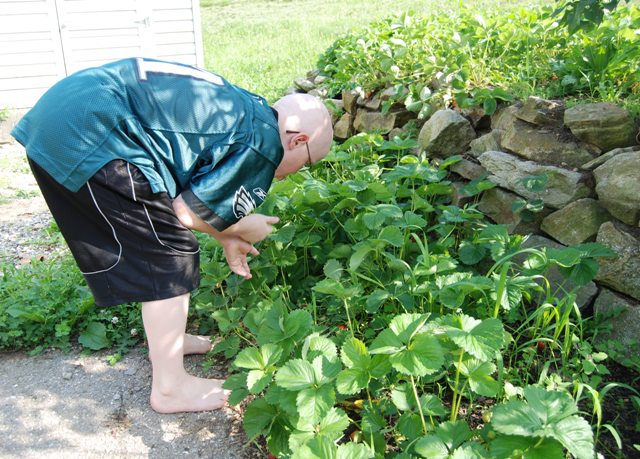
“Even the yucky ones taste great!” my youngest child called to me as we stooped in the strawberry garden, me picking and him feasting. When he says “yucky” he means not perfectly red and strawberry shaped like the ones you buy in the grocery store. That’s the thing about organic fruit, and home-grown organic fruit in particular, sometimes it doesn’t look pretty.

It’s very tempting to go for the perfect fruit over the funny looking fruit with a few bad spots. But nine times out of ten, perfect fruit has been grown with pesticide, harvested before it’s time, gassed to make it finish ripening, and then sprayed with preservative. And you can taste the difference.

My children have gotten spoiled. They don’t even want to eat the strawberries from the market that are conventionally grown somewhere far, far away. They know they don’t taste like strawberries, just the idea of strawberries. But they sure look pretty.

Same is true for other fruit. We shopped at Trader Joes today and I told my 9 year old he could “spend” $20 on the stuff he wanted. When we met up at the check-out, I was impressed with his choices of organic fruit and yogurt, and not at all surprised to see the rest of his loot come from the snack aisle.

“The organic raspberries were 60 cents more than the other kind!” he remarked. “Why would you buy the other kind?” He knows of what he speaks. The “other kind” taste like the memory of raspberries. On the drive home, we feasted, savoring the fresh sweet-tart taste of real raspberries and wishing that ours would ripen faster.

So, the next time you find yourself standing in the fruit aisle of the grocery store wondering if it’s really worth the extra 50 cents or more a pound – take it from my youngest child – why would anyone buy the “other kind”? If not for your health, than for your tastebuds. This is the only body you’ll be getting in this lifetime so take care what you put in it. Life is too short to eat chemically created strawberries!

Thursday, February 9, 2012

Food For Thought (and Health)

What to Eat? This is not only a question every person asks themselves every day, it’s also the title of a wonderful book I’ve been reading. It was a gift from my oldest son. He of the inquisitive mind must have been intrigued by the questions that pepper the cover. Questions like,
“Is organic always more nutritious? How fair is fair trade coffee? Farmed fish or wild fish? White, whole wheat, or multigrain? Are there pesticides on that apple? Are vitamin supplements safe?”
Or maybe he was just responding to his father’s nudge, “Your mom would really like that book,” when they were out Christmas shopping on a crowded afternoon and he was in a hurry to get home to his friends.

Either way, love the book. It asks all the questions I ask and some I never thought to ask. Marion Nestle is a nutrition professor, and author of two other books (soon to grace my shelves or my kindle) – Food Politics: How the Food Industry Influences Nutrition and Health and Safe Food: Bacteria, Biotechnology, and Bioterrorism.

In her book, What to Eat, Marion addresses the things that plagued the concerned parent when she or he enters a grocery store. How do you sort through all the confusing messages and buy what’s best for your family and your health? The book literally takes a tour of the grocery store expounding on every aisle with helpful, clear information.

I want to share some excellent ideas I found in the introduction. All of us struggle with the immense amount of information and the almost daily new studies that tell us what we should and shouldn’t eat to avoid health issues like cancer and heart disease, have more energy, live longer, and maintain a healthy weight. Although I’m certain there are a few factors out of our control (heredity and all the stuff we already ate that we shouldn’t have before we knew better), Marion’s simple directions make sense -

Eat less, move more, eat lots of fruits & vegetables, and go easy on the junk food.

This is a mantra we can all embrace. If we keep it in mind as we make our food and activity choices each day we can feel we’ve done all we should. Sure, the details like organic, fair-trade, GMO, locally grown, sustainably-harvested will play in to your choices, but bottom line start by eating right before you stress the rest.

Another point Marion makes in the introduction is that it’s very easy to be overcome by the marketing of food. Companies, grocery stores, and even our own government encourage us to eat things that are not good for us. As Marion points out,

The produce industry does not advertise fruits and vegetables much because its profit margins are low and its constituents are fragmented and competitive (broccoli growers versus carrot farmers, etc.). …the government does not subsidize fruit and vegetable production the way it supports corn, soybeans, sugarcane, and sugar beets….the lack of profit means that less effort goes into making sure these foods are as fresh, tasty, well prepared, and easy to use as they might be.”

I want to share one last powerful point Marion makes. It’s been darting around my mind ever since I read it. She asks the reader to consider this question:

“What industry or professional organization might benefit if you ate more healthfully?”

Like Marion, I struggle to come up with even one. I want to say the government, because then it wouldn’t have to spend nearly as much on medicare and Medicaid. But that’s a stretch, huh? In my fantasy world I would also say the government because it wants what’s best for the people. But I still reside in the real world.

Here are the industries she lists that benefit from all the confusion and bad decisions we make about nutrition and health: food, restaurant, fast-food, diet, health club, drug, and health care industries.

Food for thought. Be aware of the motivation behind the claims. And remember: eat less, move more, eat lots of fruits & veggies, and go easy on the junk food. Words to live by. Literally.

Wednesday, November 9, 2011

Define 'Organic'

I’ve had the opportunity to lead several workshops on eating organically recently, and it has led me to think long and hard about the definition of organic. Here's Webster's take on it-

Organic, adj. 1. of or having to do with an organ 2. inherent, inborn 3. systematically arranged 4. designating or of any chemical compound containing carbon 5. of, like, or derived from living organisms 6. grown with only animal or vegetable fertilizers

I’m not sure any of those definitions fit with the generally acknowledged definition most people acknowledge these days. The first comment I run in to most often, is “too expensive”. And many people, my children included, can’t help but say the word organic without a slight sneer, kind of the way Nellie Olsen talked on the original Little House on the Prairie series. Somehow organic has gone from a good idea to a trendy idea to a snobby idea.

As I thought through the message I was trying to convey at the workshops, I kept coming back to the word ‘organic’. I think there is a danger in defining ‘organic’ as the food that has received the government’s little green label. In fact, I might even venture to speculate that most of the certified organic food you find in the grocery store isn’t nearly as organic as the food you’ll find at your farmer’s market or roadside stand.

The people defining the word ‘organic’ are the people with the most to gain from that definition (and that wouldn’t be you and me). The food manufacturers have loads of money to spend on lobbyists and plenty of political power to ensure that the definition is watered down enough to make mass production of ‘organic’ food possible and profitable. If you do a little research, you’ll quickly discover that just about all of the organic brands you find in the grocery store have been bought up by conventional food manufacturers. It’s a bit of a curse to be successful at an organic start up; it virtually guarantees your days are numbered.

Truly it’s a free for all. Just about anything can be twisted in to acceptance with the right amount of influence and legal documents. There are over 500 exceptions (probably hundreds more since my source is over a year old) for pesticides, preservatives, additives, food colorings, artificial flavorings, and stabilizers in organic food. At a workshop I led for young mothers, I was hard pressed to come up with an answer to the question, “What kind of organic snack can I give my toddler?” Fruit, being my first response, isn’t always practical. And the overpriced organic snack food being hoisted on well-meaning mothers, isn’t necessarily any better than the goldfish crackers and cheezits I raised my children on. It’s a tough call. And there is no simple answer.

Until we are all ready to go back to growing all our own food or knowing the person who grows it for us, the best we can do is the best we can do. I still keep harping on label reading. It’s pretty much your only weapon against the marketing. Much of the “organic” processed food you find in the grocery store has only a few organic ingredients, most likely just enough to qualify for the little green and white seal.

I was reading today that Horizon organics, who own more than 50% of the market on organic dairy products, keep their cows in a grassless feed lot and stuff them full of “organic” feed. They have so many cows at their manufacturing facility in southern Idaho, it’s a statistical impossibility to keep them on grass (the acreage they would cover would make it impossible to gather them in to the milking barn three times a day). I’m guessing it’s the same situation at their international facilities too. And I have to stifle a giggle at the idea of “organic” cow feed. With all the shenanigans involved with certifying organic people food, I have to wonder who’s certifying organic cow food? My guess it’s pretty much a fox guarding the hen house.

So which is better - milk you buy from local farms who don’t proclaim to be “organic” but graze their cows on fresh grass every day, or certified “organic” milk shipped to you from across the country or continent?

I’m truly getting tired of the “organic” label. I’m not sure it means anything anymore. I think we need to talk about ingredients and processes because they mean much more than the indulgent, expensive certification process that costs us as taxpayers and as consumers.

No one wants to hear this, but it’s the message I have to keep spreading – make your own food. Don’t groan and roll your eyes at me. It’s not difficult and many times it’s not even very time consuming. And for sure, it saves you money. Deciding to make your own food is a mind set. It requires moving beyond the part of you that says, “I can’t do this.” Sure, in the beginning it will take a little work, some serious research, and a rearranging of priorities.

It seems to me, as I watch the lines at the fast food drive through and the overflowing carts at Walmart, that most people are sheep. They are following everyone else, trusting that if they are eating it and the store is selling it and the government is allowing it, than it must be OK.

Sure, it won’t kill you, at least not today. All you have to do is look at our ever-expanding population to know that we can survive on artificially colored, chemically-created, pesticide and preservative laden food. We can live just fine. All we’ll need is seriously good health insurance and some major savings to support us when our bodies finally max out on the toxins and we have to pay the piper. Not to be all doom and gloom, I’m just saying.

My mother-in-law tells me that I need to be sure my readers know that I’m not super-woman, that I truly don’t get it right all the time. So let me tell you what I brought home from the grocery store last night for my 15-year-old’s upcoming birthday gathering this weekend. (he chose the menu) – cheezits in multiple flavors, tortilla chips, pretzels, mountain dew, sierra mist in that bright red color you know is laden with Red No. 5, and several ridiculously impossible “fruit” juices that claimed to be “100% from concentrate” (which means, what?). And on Saturday I will bake a cake laden with fat and chocolate and real cream and then we’ll order pizza from a parlor. And I promise that not once will I say “you shouldn’t eat that”!

I don’t want to be the “food nazi” as Stephen Colbert accused Michael Pollan of on his show this week. My oldest son is a huge fan (of Colbert, not Pollan) and enjoyed sharing the clip with me. Pollan took the chiding very well, but he also made his point – people need to eat real food. He didn’t talk about organics, he talked about common sense.

I think we need to remember that eating “organic” (for lack of a better word) is not an all or nothing venture. Every change we make that moves us towards a healthier life is progress, however small. It’s time to take responsibility for our food. It’s dangerous to trust our family’s health to the government, the food manufacturers, or the grocers. We need to know what we are eating. Or as my favorite quote says, “If you are what you eat and you don’t know what you’re eating, how do you know who you are?”

Defining the word ‘organic’ in terms of our food system is difficult, as it seems to be an ever-evolving claim, but defining organic as food that is real, honest, and good for our bodies might be a step in the right direction.

Thursday, July 29, 2010

Are We Round Up Ready?

As we were riding our bikes past the farm fields near our house this weekend, my husband commented, “Look! Round Up resistant corn growing in the Round Up resistant soybeans!” Sure enough, there were corn stalks here and there within the neat rows of soybeans. No weeds, but occasional corn stalks. Round Up resistant seeds are GMO seeds engineered to survive applications of Round Up. That way, the farmer can spray his fields with Round Up and kill everything but the seeds which just soak it in. Pretty neat, huh? 91% of soybeans, 85% of corn and 88% of cotton in the US are grown from GMO seeds according to the USDA Economic Research Service. Must work great as it’s so popular.

It does work great, but at what cost? I’ve been reading Maria Rodale’s book Organic Manifesto and learning enough to become alarmed at our government’s complicity, the ignorance in the general population (I’m one of those ignorami), and the rock and hard place that farmers are caught between. Here’s the thing with Round Up – it’s not just ON the plants, it’s IN the plants. So when you eat that soy product (and believe me you do eat soy products since soy is added to nearly everything, just ask someone who’s allergic to it!), you’re eating some lovely Round Up altered cells. You can’t just wash off the pesticide because it’s now part of the genetic make up of the plant. Dr. Warren Porter, a zoology and environmental toxicology professor at the University of Wisconsin points out, Round Up is “in the plant, not just on the plant. Fat soluble chemicals in Round Up have the master entry key into the plant and into our bodies, because every cell in our body is a fatty membrane. So anything that is fat soluble can cross the blood-brain barrier and also the placental barrier.”

I must confess that there is Round Up in my garage. My husband, like all of us, has been convinced that Round Up is safe for home use. Monsanto (imagine me invoking this name with a very cynical and disgusted voice as I believe their ethics are right on par with Enron management), the maker of Round Up, has a powerful marketing department and even more powerful government lobbyists. Before Roundup Ready soybeans were on the market, the acceptable ppm (parts per million) was 3, but the new Round Up Ready soybeans had something in the neighborhood of 20ppm. Somehow that year the EPA decided that 20ppm was a more appropriate limit. Hmmmm. Makes you scratch your head, doesn’t it? It’s a bit of a bait and switch – we’re all worried about run-off from the fields and the toxins in the air from the Round Up as it is sprayed and here what we really need to be worried about is the Round Up in the food we eat. As Maria Rodale points out, we may not just be exterminating weeds and pests, we may just be exterminating ourselves.

So what’s so bad about Roundup Ready Seeds and GMOs anyway? I mean, the government allows its use, so it must be safe. Tell that to the European Union where GMO seeds are currently banned. The American Academy of Environmental Medicine has called for an immediate “moratorium on genetically modified food.” The reason? “Several animal studies indicate serious health risks associated with GM food consumption including infertility, immune dysregulation, accelerated aging, dysregulation of genes associated with cholesterol synthesis, insulin regulation, cell signaling, and protein formation, and changes in the liver, kidney, spleen and gastrointestinal system.” But I’m not sure we really need a doctor to tell us this if the food we’re eating got to our table because it’s toxic to weeds and pests. It is only logical that it is toxic to us also.

So how do we avoid GMO foods?

Check out the sticker on the produce you buy, if it’s organic it will have a five digit number that starts with 9, but if it has five digits and the number begins with 8, put it back in the bin because it is a GM product. Conventionally grown (non-organic) produce has four digit numbers.

Most processed food contains GMO ingredients, no way around that and because our government hasn’t done the research to determine if GMO food is safe, you’re taking the risk yourself. I know I always come back to this, but make it yourself – avoid processed food. Know what you’re putting in your body.

If you insist (or can’t avoid) eating processed foods, read the label carefully, if any of the following ingredients are found and aren’t specifically labeled as organic, you are most likely holding a food that contains GMO ingredients:

Soybeans (including oil, flour, protein, and concentrates), corn (including oil, syrup, starch, flour), canola oil, dairy products, and meat products.

I highly, highly, highly recommend the book Organic Manifesto by Maria Rodale as important reading for all of us. She is sounding an alarm and her carefully researched and thoughtfully expressed opinions could shape our futures – if we let them. It’s a short book, she keeps to the point and it’s a fascinating read – I promise you’ll have trouble putting it down. I can’t promise it will help you sleep at night.

Friday, February 20, 2009

A cheese curl is not just a cheese curl...

There are lots of scientific studies and tragic case histories that document the benefits of eating organically. I’m horrible at remembering the numbers and the details. I can’t even pronounce, let alone recall, the names of specific ingredients found in processed foods or the chemicals found in pesticides and preservatives that are killing us. All I know is that eating organically makes sense and I feel better and my kids are healthier for it. Many diseases and disorders are on the rise and much of the time we throw up our hands and feel pretty helpless. There are lots of factors at play here – how could we possibly figure it all out? We can’t. But we are not helpless and there are some things that we can change. What we eat and what we feed our kids is a biggie.

Most of us don’t think too much about what happens to our food once it gets past the taste buds. We don’t consider that our bodies are machines that require certain nutrients. They don’t need a lot of what we put in them. Just because something tastes good, doesn’t mean it’s good for us. We all know that – our mothers told us that when we were three and wanted to live on candy. We feed our body lots of things it doesn’t need and was never meant to process.

I’ve been around horses most of my life. Colic is the biggest killer of horses. Colic is really just a symptom – intestinal pain. The reason you can have intestinal pain and feel better in 24 hours yet it kills horses is simple. Horses’ systems only work in one direction. Horses can’t throw up. So if they eat something their body can’t process, it will kill them. Happens all the time.

Eating things that our bodies are not meant to process can’t possibly be good for us. And most likely it is hurting us. If you put the wrong gas or oil in a machine and try to run it, it may run, but not well. Do this long enough and the entire engine might seize up. When we make our body process things we are not meant to process it weakens our health and it can cause systems to break down.

That said, just because something is organic doesn’t mean it is good for us either. My kids were really excited to discover that there is such a thing as an organic cheese curl and an organic chocolate chip cookie. There’s even organic soda. If I must, I will buy these things to pacify my children and keep them on board with our organic life, but I try not to. I know that the food they need is whole and honest and recognizable. Be careful as you head down this organic path that you don’t assume that the green and white symbol is a green light. A general rule of thumb for me is to stick with unprocessed food and do the processing myself. That way if they're eating chocolate chip cookies at least I know what went in to them (including the extra ½ cups of ground flax seed and almond meal!).